Engaging Back-To-School Activities for Every Subject

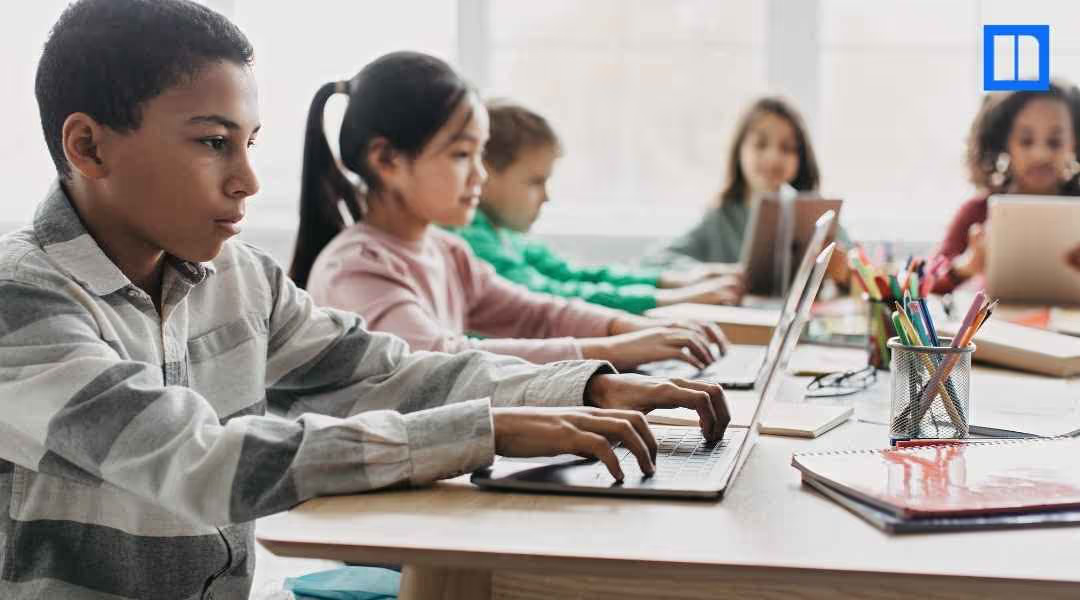
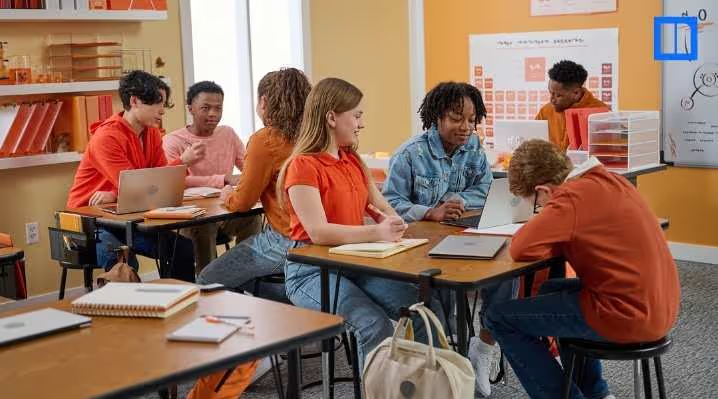
Children studying on a laptop together
July 1, 2026

Don’t you just love returning to school in the fall? Does it make you want to buy classroom supplies? “You’ve Got Mail” humor aside, going back to school is a pretty exciting time for you and your students. 

To make the transition smooth, fun, and engaging this year, we’ve collected some easy-to-use back-to-school activities to help you start the new year off right!

[ELA back-to-school activities for reading, writing, and classroom community](id-ela)

Key Takeaways

  • Ready-to-use ELA resources help you start with units, videos, poems, debates, and text sets instead of building every lesson from scratch.
  • Community-building themes give students safe ways to discuss identity, growth, friendship, and new beginnings while practicing literacy skills.
  • Flexible grade-level options make it easier to match back-to-school activities to elementary, middle, and high school learners.

Use the first days of school to help students reconnect with reading, writing, and discussion. These ELA back-to-school activities give you ready-to-use ways to build classroom communities and get students practicing literacy skills right away.

Start with ELA units about growth, identity, and new beginnings

Start the year with focused ELA units that help students talk about community, relationships, goals, and identity. Each unit gives you texts, skills practice, and a performance task that you can use to build classroom connections and literacy skills practice. 

ELA units

Back-to-school ELA units by grade level

Use these ELA units to help students reflect on growth, relationships, community, identity, new beginnings, routines, and resilience.

Scroll left to right to see the full table.

Unit Grade levels What students do Essential question
Power of Play 2–5 Students explore why play matters, read fiction and nonfiction texts, and create their own game. Why is it important to have opportunities to play?
Relationships in Action 3–5 Students learn about different relationships, friendship, and relationship stories before creating a brochure. What value do different relationships have in our lives?
The Strength of Communities 3–5 Students examine types of communities, community action, and challenging times before creating an improvement plan. How do communities show strength during challenging times?
What Creativity Means 3–6 Students connect creativity to problem-solving, community, and self-expression before creating a collage. What does it mean to be creative?
Goals and Growing 3–6 Students learn goal-setting strategies, explore self-compassion, and write about how they hope to grow. How would you like to grow this school year?
Interests and Who You Are 5–8 Students reflect on identity, interests, and hobbies before creating a product about who they are. Who am I? How do my interests relate to my identity?
The Power of the Internet 7–9 Students analyze connection, social media, internet access, and opinion texts before writing an argument. Does the internet make us closer or farther apart?
New Beginnings 7–10 Students explore new beginnings, community, and belonging before writing a personal profile. How can we embrace new beginnings to foster a class community and support our academic success?
Reestablishing Routines 9–12 Students review routines, goals, accountability, and academic communication before writing a professional email. How can we reestablish routines and habits to support our academic success?
Resilience and Processing Change 9–12 Students reflect on challenges, setbacks, growth, and hope before writing a personal narrative. How can resilience benefit us in our personal and academic pursuits?
Building Self-Management Skills for the Future 9–12 Students learn about growth mindset, stress, self-discipline, and initiative before writing a narrative. How can self-management skills help us succeed in high school and beyond?

Use back-to-school videos to support literacy skills and discussion

Videos can help students ease back into learning while practicing skills like listening and close viewing. Browse Newsela ELA’s collection of videos for all learners to bring multimodal learning support to your classroom.

Introduce younger students to Generation Genius ELA videos 

Generation Genius ELA videos give K–5 students a friendly way into literacy skills, with animated characters and supporting instructional materials you can use to kick off lessons, review concepts, or spark quick class discussions.

Generation Genius ELA videos

Generation Genius ELA video collections by grade band

Use these video lessons to introduce or review literacy skills with elementary students.

Related blog

Meet the Learning League, Your Students’ New Learning Buddies

Get to know the Generation Genius ELA characters students will see across these video lessons.

Read the blog

Share curated back-to-school videos for multimodal learning

Use curated back-to-school videos to bring multimodal learning into the first weeks of the new year. These selections can support quick writes, partner discussions, and class conversations. 

Curated back-to-school videos

Back-to-school videos by grade level and runtime

Use these short videos to spark discussion, build background knowledge, and help students practice literacy skills through multimodal learning.

Scroll left to right to see the full table.

Video Grade levels Runtime Use it for
Overcoming obstacles 4–5 4:14 Discussing perseverance and growth.
What makes education different from school? 6–8 2:45 Talking about learning, school, and purpose.
Can you really change your personality? 6–8 4:08 Reflecting on identity and personal growth.
Saying no to peer pressure 6–8 4:24 Discussing decision-making and relationships.
How miscommunication happens (and how to avoid it) 6–8 4:32 Building communication and discussion norms.
Growth mindset vs fixed mindset 6–8 5:03 Introducing goal setting and academic habits.
Where do new words come from? 6–8 5:08 Sparking curiosity about language.
How will AI change the world? 6–8 5:40 Discussing future-ready skills and technology.
What is plagiarism, and how do I avoid it? 6–8 7:09 Reviewing academic honesty and source use.
How to write and send an email to your teacher: Step by step guide for students in Gmail 6–8 8:15 Practicing academic communication.
Taking notes 6–8 8:28 Reviewing study skills and classroom routines.
Meet your master: Getting to know your brain 6–8 12:33 Talking about learning and the brain.
Why storytelling is so powerful 6–12 2:20 Launching personal narratives and class storytelling.
Dream Jobs: Literature professor 6–12 5:26 Connecting literacy to careers.
Want to change the world? Start by being brave enough to care 6–12 11:00 Discussing empathy, courage, and action.
10 ways to have a better conversation 6–12 11:44 Building discussion routines and listening skills.
America Ferrera: My identity is a superpower—not an obstacle 6–12 14:02 Exploring identity, voice, and belonging.
How to speak so that people want to listen 9–12 9:54 Practicing presentation and speaking skills.
Chimamanda Ngozi Adichie: The danger of a single story 9–12 18:46 Discussing perspective, identity, and bias.

Assign first-day-of-school poems and fiction about friendship, growth, and goals

Poetry is a low-lift way to start the year with close reading and reflection. Use these first-day-of-school poems to help students think about topics like friendship, growing up, and goals they want to set for the year.

First-day-of-school poems

Poems for friendship, growth, and goal setting

Use these poems to start quick writes, close reading, partner discussion, or reflection activities during the first days of school.

Scroll left to right to see the full table.

Poem Author Grade levels Themes
“A Time to Talk” Robert Frost 2–8 Friendship, connection, making time for others
“Werewolf Charm School” Ben Eggertsen 4–8 School routines, belonging, humor
“On Friendship” Kahlil Gibran 4–5 Friendship, trust, community
“There Is No Frigate Like a Book” Emily Dickinson 4–12 Reading, imagination, curiosity
“Hope” Alice Dunbar-Nelson 4–12 Hope, resilience, optimism
“Songs for the People” Frances Ellen Watkins Harper 4–12 Community, service, voice
“Dreams” Langston Hughes 4–12 Dreams, goals, perseverance
“My People” Langston Hughes 4–12 Identity, belonging, pride
“As I Grew Older” Langston Hughes 6–12 Growing up, dreams, overcoming obstacles
“If” Rudyard Kipling 6–12 Character, perseverance, self-management
“Up-Hill” Christina Rossetti 6–12 Journey, endurance, uncertainty
“Instructions on Not Giving Up” Ada Limón 9–12 Resilience, renewal, perseverance

Build independent reading routines with fiction and poetry collections

Give students choice early in the year with fiction and poetry collections tied to back-to-school themes. These collections work well for independent reading, book talks, reading conferences, or quick response journals.

Independent reading

Back-to-school fiction and poetry collections

Use these themed collections to help students choose texts that connect to who they are, where they are going, and how they want to grow this school year.

Scroll left to right to see the full table.

Genre Purpose Sample selections
Fiction About Belonging and Fitting In Help students discuss acceptance, difference, and what it means to find your place.
  • “The Little Mermaid” by Hans Christian Andersen
  • “The Ugly Duckling” by Hans Christian Andersen
  • “Frankenstein”: Chapter 11 by Mary Shelley
Poetry About Belonging and Fitting In Use poems to help students reflect on community, comfort, and connection.
  • “Good Hours” by Robert Frost
  • “The Lake Isle of Innisfree” by William Butler Yeats
  • “Our Blanket” by Lelila Lakhal
Fiction About Choices Prompt students to think about decisions, consequences, and character motivation.
  • “Jack and the Fish” by Rex Ellis
  • “Her Hands That Held the Stars” by Rebecca Birch
  • “The Scarlet Letter”: Chapter 2 by Nathaniel Hawthorne
Fiction About Growing Up Support reflection on change, independence, and the experiences that shape students.
  • “Solo on the Subway” by Diana C. Conway
  • “The Return of Sal Caputo” by Timothy Tocher
  • “Treasure Island”: Chapter 1 by Robert Louis Stevenson
Poems About Growing Up Invite students to write about change, goals, and the parts of childhood they carry forward.
  • “Aspiration” by Henrietta Cordelia Ray
  • “Nothing Gold Can Stay” by Robert Frost
  • “Season of Change” by C.L. Clickard
Fiction About Identity Help students explore identity, self-expression, and how characters understand themselves.
  • “The Peacock and Juno” by Aesop
  • “Hermia’s Shell” by Bish Denham
  • “Désirée’s Baby” by Kate Chopin
Poems About Identity Use poetry to open reflection on voice, selfhood, and belonging.
  • “Song of Myself” by Walt Whitman
  • “I’m Nobody! Who are you?” by Emily Dickinson
  • “Grace” by Joy Harjo
Fiction About Journeys Connect back-to-school transitions to stories about movement, challenge, and discovery.
  • “The Tortoise and the Hare” by Aesop
  • “A Spectacular Ride” by Drollene P. Brown
  • “Around the World in Eighty Days”: Chapter 1 by Jules Verne
Poems About Journeys Encourage students to think about where they have been and where they are headed next.
  • “blessing the boats” by Lucille Clifton
  • “Up-Hill” by Christina Rossetti
  • “Flying” by Kurt Metzler

Lead back-to-school debates about school routines and expectations

Back-to-school debates give students a structured way to practice argument, evidence, and speaking. Use these school-related topics to help students discuss routines and expectations they already have opinions about.

Classroom discussion

Back-to-school debate topics for ELA

Use these debate topics to help students practice argument writing, text evidence, accountable talk, and respectful discussion.

Scroll left to right to see the full table.

Debate topic Grade levels Questions students can debate
Should Teachers Assign Homework? 3–12
  • Why do schools traditionally assign homework?
  • What alternatives could teachers use to assess student growth?
  • Who is in favor of homework? Who is against it?
  • What are the benefits and drawbacks of homework?
When Is the Best Time for School to Start? 4–12
  • What do doctors and scientists say about teenagers’ sleep needs?
  • Why do middle and high schools often start early?
  • What are the benefits of later school start times?
  • What are the drawbacks of starting school later?
Should Schools Have Dress Codes or Uniforms? 6–12
  • Why have schools used dress codes or uniforms?
  • What are the benefits of dress codes or uniforms?
  • What are the drawbacks of dress codes or uniforms?
  • How might dress codes discriminate against students?

Debate worksheets and resources

Support students before, during, and after the debate

Plan the argument

Help students organize claims, evidence, and reasoning before they speak or write.

Debate Graphic Organizer Debate Text Evidence Graphic Organizer
Guide the discussion

Give students sentence frames they can use to respond, agree, disagree, and build on ideas.

Accountable Talk Sentence Starters
Reflect and assess

Wrap up the activity with reflection and a rubric for discussion or argument skills.

After Debate Reflection Debate Rubric

Use teacher-created ELA text sets for ready-made back-to-school lessons

Need a quick lesson that already has a clear purpose, timing, and a connection to standards? These teacher-created text sets can help students build empathy, practice opinion writing, and explore a growth mindset during the first weeks of school.

Teacher-created lessons

Back-to-school ELA text sets created by teachers

Use these ready-made lessons to start the year with student reflection, discussion, writing, and Newsela navigation practice.

Scroll left to right to see the full table.

Text set Grade levels Objective Time Standards
Kindness is Contagious
2–8 Students learn how people can build empathy by sharing stories and experiences. 50–60 minutes RI.5.1 RI.5.2
Beginning of the Year Scavenger Hunt
3–12 Students navigate Newsela and explore its features by completing a scavenger hunt. 60 minutes CCRA.R.2 CCRA.R.4 CCRA.R.7 CCRA.R.10
Back-to-School Opinion Writing
4–5 Students identify opinion writing structure, then write an opinion piece using a mentor text. Three 60-minute lessons or five 30-minute lessons W.4.1 W.5.1
Growth Mindset: What Moves Us?
6–12 Students learn about growth mindset, motivation, goal setting, and sketchnoting. 3–5 lessons over multiple days CCRA.R.2 CCRA.R.10 CCRA.W.7 CCRA.SL.2

[Social studies back-to-school activities for inquiry and discussion](id-ss)

Key Takeaways

  • Inquiry-based activities make the first weeks more meaningful. Students can start the year by asking questions, analyzing sources, and connecting social studies topics to their own lives.
  • Ready-made collections save planning time. Core courses, electives, primary sources, and videos give you flexible ways to launch routines without building every lesson from scratch.
  • Discussion routines build classroom community. Icebreakers, media literacy prompts, and historical thinking activities help students practice listening, evidence use, and respectful conversation.

Use social studies activities to build discussion routines, spark curiosity, and introduce students to inquiry skills. These resources can help you start the year with primary sources, videos, and ready-made collections that support evidence-based thinking.

Build classroom community with social studies icebreaker activities

Start your first week of social studies classes with activities that help students get to know one another while practicing inquiry, discussion, and source analysis. These icebreakers connect the classroom community to skills students will use all year.

Social studies icebreakers

Back-to-school icebreaker activities for social studies

Use these activities to help students build relationships while exploring geography, storytelling, media, history, civics, and culture.

Scroll left to right to see the full table.

Icebreaker Grade band What students do CASEL alignment
Around the World! 3–12 Students write about a place they want to visit, share responses in a name game, and extend learning by researching a region or continent. Social Awareness Relationship Skills Responsible Decision-Making
Tell Me a Story 3–12 Students share personal stories, rotate partners, discuss what they learned, and connect storytelling to social, cultural, and historical value. Self-Awareness Social Awareness Relationship Skills Responsible Decision-Making
Map It Out 6–8 Students work in groups to create a school map, join a gallery walk, vote on maps, and discuss why maps matter. Self-Management Relationship Skills Responsible Decision-Making
Create a Country 9–12 Students answer get-to-know-you prompts, design an imaginary country, and connect the activity to trade, resources, and geography. Self-Awareness Relationship Skills Responsible Decision-Making
Who Am I? 6–12 Students ask yes-or-no questions to identify a celebrity or historical figure, then explore that person’s cultural, political, or historical impact. Relationship Skills Responsible Decision-Making
Time Capsule 6–12 Students choose items for a future time capsule, explain their significance, and extend the activity with historical source analysis. Self-Management Social Awareness Relationship Skills Responsible Decision-Making
Choose a Color 6–12 Students choose a color, answer a mystery question, identify related social studies branches, and summarize a current events connection. Self-Awareness Relationship Skills Responsible Decision-Making
In the Media 6–12 Students discuss media power, write a short article about an interesting topic, and analyze a past or present source. Social Awareness Relationship Skills

Plan core social studies courses with ready-to-use collections

Use Newsela Social Studies course collections to start planning units, pacing, and skill review for the year ahead. These core collections give you flexible instruction options for a variety of topics that may be part of your state curriculum or standards.

Core social studies courses

Ready-to-use Newsela Social Studies course collections

Use these collections to plan units, introduce key topics, and support inquiry-based social studies instruction throughout the school year.

Scroll left to right to see the full table.

Course collection Grade levels What students explore Sample units
AI Literacy Collection 3–12 Students build foundational AI literacy and explore how data, algorithms, and privacy shape digital life.
  • Foundations of AI
  • Algorithmic Thinking and Data Analysis
  • Data Privacy and Security
Black U.S. History 6–12 Students examine Black U.S. history from West Africa and North America through the modern era.
  • What Is Black U.S. History?
  • Independence for Whom?
  • A Job Unfinished
Civics and Engaged Citizenship 6–12 Students learn about government structures, rights, responsibilities, policy, participation, and global citizenship.
  • Foundations of Government
  • Rights and Responsibilities of the People
  • Political Participation
Economics and Financial Literacy 6–12 Students develop economic reasoning and connect economic concepts to personal finance decisions.
  • Fundamental Economic Concepts
  • The Global Economy
  • Financial Literacy
Exploring World Geography 6–12 Students explore geography across world regions and build background knowledge about places, people, and environments.
  • Geography of North America
  • Geography of Africa
  • Geography of East and Southeast Asia
Exploring World History 6–12 Students study major eras, movements, conflicts, revolutions, and global issues across world history.
  • European Renaissance and Reformation
  • The Industrial Revolution
  • Contemporary Global Issues
The Newsela Elementary Social Studies Collection K–5 Students build early social studies knowledge through rules, maps, civics, community, elections, and government.
  • Map Skills
  • Community
  • Constitution and Government
Unearthing Ancient Civilizations 6–12 Students investigate ancient civilizations, early societies, and historical developments across regions.
  • Ancient Egypt
  • Ancient India
  • Ancient and Classical Rome
United States History: Pre-Contact to Modern Times 6–12 Students examine U.S. history from 1600 to the present through multiple lenses and diverse perspectives.
  • Development of U.S. Constitutional Democracy
  • Course and Consequences of World War II
  • Contemporary America

Explore high school social studies electives

For high school students, elective collections can help connect social studies to a variety of special interests and career paths. Use these ready-to-use collections to introduce course options, preview units, or build flexible lessons around student interests.

High school social studies electives

Ready-to-use elective collections for high school social studies

Use these elective collections to help students explore specialized social studies topics and connect course content to real-world questions.

Scroll left to right to see the full table.

Elective collection What students explore Sample units
Art History Students study architecture, painting, sculpture, and photography from Western and non-Western traditions.
  • Art Appreciation
  • Global Prehistoric and Ancient Art
  • Renaissance and Baroque Art
Comparative Religions Students explore the history, holidays, core beliefs, and contemporary issues connected to world religions.
  • Judaism
  • Christianity
  • Contemporary Religious Issues
Constitutional Law Students examine the U.S. Constitution, government structure, individual rights, landmark Supreme Court cases, and constitutional debates.
  • Foundations of the U.S. Constitution
  • The Bill of Rights and Individual Liberties
  • Contemporary Constitutional Issues
Economics Students study economic systems, market behavior, national policy, global markets, and personal finance.
  • Foundations of Economics
  • Economic Systems and Markets
  • Economics in Personal Finance
Psychology Students explore major psychological theories, research methods, brain function, mental health, and social influences on behavior.
  • Introduction to Psychology
  • Research Methods in Psychology
  • Mental Health and Disorders
Sociology Students examine how society shapes human behavior through culture, social institutions, socialization, and social groups.
  • Intro to Sociology
  • Culture
  • Socialization
Women’s Studies Students learn about women’s experiences, contributions, social roles, and advancement in American history and global contexts.
  • Women in Early History
  • Women in American History
  • Women Working Today

Teach primary source basics with leveled historical texts

Primary sources help students practice evidence-based discussion and context at the start of the year. This collection includes a variety of primary sources at multiple reading levels, so all students can access the concepts you want to discuss.

Primary source practice

Primary sources for back-to-school social studies lessons

Use these primary sources to introduce sourcing, perspective, context, close reading, and evidence-based discussion.

Scroll left to right to see the full table.

Primary source Grade levels | Reading levels Use it for Spanish Sensitive Content
Two views on the prospect of American independence
Address/Letter
4–8 | 400L–1450L Comparing Loyalist and Patriot perspectives on American independence. ✓ Yes
The Anti-Federalist Papers, Brutus 1
Essay
4–12 | 580L–1440L Analyzing arguments against ratifying the Constitution. ✓ Yes
Gertrude Weil’s letters on women’s suffrage
Letter
4–12 | 480L–1120L Exploring suffrage, civic action, and women’s rights advocacy.
Excerpt from the “Narrative Life of Frederick Douglass, an American Slave”
Memoir excerpt
4–12 | 570L–1110L Reading an autobiographical account connected to slavery, freedom, and voice. ✓ Yes
The separation of Charles Ball’s family
Memoir excerpt
4–12 | 550L–1440L Discussing family separation, slavery, and historical testimony.
“For the Equal Rights Amendment” by Shirley Chisholm
Address
6–12 | 570L–1290L Analyzing constitutional arguments, equality, and persuasive rhetoric.
The Articles of Confederation
Document
6–12 | 590L–1860L Introducing the first U.S. government and its limitations. ✓ Yes
The Bill of Rights
Document
6–12 | 570L–1590L Reviewing rights, amendments, and constitutional protections. ✓ Yes
The Declaration of Independence
Document
6–12 | 530L–1420L Studying founding ideals, grievances, and independence. ✓ Yes
The Declaration of Sentiments, Seneca Falls Conference
Document
6–12 | 660L–1460L Connecting women’s rights, reform movements, and founding language. ✓ Yes
James Madison’s Federalist Papers No. 10
Essay
6–12 | 730L–1420L Analyzing Federalist arguments, factions, and constitutional debate. ✓ Yes
Lincoln’s Emancipation Proclamation
Executive Order
6–12 | 740L–1960L Examining emancipation, executive power, and the Civil War. ✓ Yes
Martin Luther King’s Letter from Birmingham Jail
Letter
6–12 | 480L–1220L Examining civil rights, direct action, and persuasive writing. ✓ Yes ✓ Yes
The Ride of Paul Revere
Letter
6–12 | 540L–1280L Clarifying historical evidence connected to Paul Revere beyond the famous poem. ✓ Yes
Colonial voices on religious diversity
Memoir
6–12 | 450L–1280L Discussing religious diversity and perspectives in colonial history. ✓ Yes
The life of Venture Smith, an enslaved African brought to America
Memoir
6–12 | 530L–1180L Exploring enslavement, biography, agency, and historical memory.
Jefferson’s Notes on Slavery
Notes
6–12 | 660L–1230L Discussing slavery, contradiction, and founding-era perspectives. ✓ Yes
Malcolm X’s “The Ballot or the Bullet,” April 3, 1964
Speech
9–12 | 600L–1000L Analyzing voting rights, civil rights, argument, and rhetoric. ✓ Yes

Use social studies videos to introduce media literacy, civics, and culture

Take learning beyond icebreakers and primary sources with short social studies videos that build background knowledge, support discussion, and promote multimodal learning.

Social studies videos

Back-to-school videos for media literacy, civics, and culture

Use these videos to introduce discussion topics, build background knowledge, and support multimodal social studies learning.

Scroll left to right to see the full table.

Video Grade levels Runtime Use it for
News literacy: How does bias impact how we see world events? 4–5 2:09 Introducing media bias and news literacy.
Mapping world history 4–5 2:21 Connecting maps to historical thinking.
Why do some people have more access to technology than others? 4–12 1:57 Discussing technology access and equity.
How are we shaped by our culture? 4–12 2:40 Introducing culture, identity, and belonging.
Designing the Constitution: Learning from our ancestors 6–8 2:04 Previewing constitutional ideas and historical influence.
What is a citizen? From Ancient Athens to the U.S. 6–8 2:09 Introducing citizenship across historical contexts.
The Declaration of Independence 6–8 2:27 Reviewing founding ideals and independence.
What is human geography? 6–8 9:19 Introducing geography through people, places, and patterns.
How geography shapes a culture 6–12 1:48 Connecting geography, environment, and culture.
How can you use technology to become a more active global citizen? 6–12 1:54 Discussing digital citizenship and global awareness.
How can governments represent people? 6–12 2:12 Introducing representation and government systems.
What makes a civilization? 6–12 3:58 Previewing ancient civilizations and historical patterns.
The rise and fall of history’s first empire 6–12 5:21 Discussing power, empire, and historical change.
Separation of powers and checks and balances 6–12 8:01 Reviewing branches of government and checks on power.
Political parties 6–12 8:54 Introducing political parties and civic participation.
Bias in the media 6–12 16:07 Analyzing media bias and source evaluation.
The Bill of Rights: Cornerstone of U.S. society? 9–12 2:15 Discussing rights, civic values, and constitutional protections.
The dark(er) side of media 9–12 9:58 Exploring media influence and critical consumption.
Introduction to media literacy 9–12 10:05 Introducing media literacy skills and discussion norms.

Use teacher-created social studies text sets for back-to-school lessons

Need a quick social studies lesson that helps students talk, think, and investigate right away? These teacher-created text sets cover a variety of key topics with options for elementary, middle, and high school learning.

Teacher-created lessons

Back-to-school social studies text sets created by teachers

Use these ready-made lessons to help students explore identity, citizenship, voting, social systems, and exploration during the first weeks of school.

Scroll left to right to see the full table.

Text set Content areas Grade levels Learning objective Time
Media’s Impact on Creating Our Own Identity
ELA Social Studies SEL/Life Skills 3–5 Students learn how the world around them can have positive and negative effects on the identities they create. 3–4 45-minute class periods
Explorers: Past, Present, Future
ELA Science Social Studies 4–6 Students investigate the question: What does it mean to be an explorer? 3–4 30-minute lessons
With Rights Come Responsibilities
ELA Civics Social Studies 6–12 Students learn about the rights and responsibilities of U.S. citizens and differentiate between a right and a civic responsibility. 4–5 50-minute class periods
The Role of Voting in American Democracy
Social Studies 7 Students consider the impact of voting, the role of political parties, and the voting process. 45–60 minutes
Global Social Hierarchies
Social Studies 9 Students learn how social systems have impacted people around the world. 2 class periods

[Science and STEM back-to-school activities for hands-on learning](id-sci)

Key Takeaways

  • Interactive STEM activities help students reengage quickly. Simulations, videos, and diagrams give students multiple ways to explore concepts during the first weeks of school.
  • Science routines start with observation and inquiry. Back-to-school lessons can help students practice asking questions, using models, analyzing visuals, and discussing evidence.
  • Ready-made resources support smoother planning. Science safety, tools, careers, math review, and inquiry resources give you flexible options for launching STEM learning.

Start the year with interactive science and STEM activities that get students observing, questioning, modeling, and discussing right away. These resources help you introduce inquiry routines and review key skills through hands-on, multimodal learning.

Use PhET simulations to launch interactive STEM lessons

PhET simulations give students a hands-on way to test ideas, manipulate variables, and discuss what they notice—without having a full lab or tools at their fingertips. Use these back-to-school selections to introduce key concepts that you’ll return to all year long.

Interactive STEM simulations

PhET simulations for back-to-school STEM lessons

Use these simulations to help students ask questions, test models, analyze data, and make observations across science and math topics.

Scroll left to right to see the full table.

Simulation Science or math focus Students can practice Standards
Circuit Construction Kit: DC Physics Engineering Make observations about energy transfer and ask questions about electric and magnetic forces. 3.2.4.B 3.2.6-8.I
Membrane Transport Biology Biochemistry Use models to describe cell function and investigate evidence that living things are made of cells. 3.1.6-8.B 3.1.6-8.A
Mean: Share and Balance Mathematics Statistics Data Science Analyze measures of center, describe patterns and deviations, and summarize data distributions. M06.D-S.1.1.2 M06.D-S.1.1.3 CC.2.4.6.B.1
States of Matter: Basics Physics Chemistry Compare substance structure and model how potential energy changes when interacting objects rearrange. 3.2.9-12.B 3.2.6-8.P
Gravity and Orbits Physics Use evidence, mathematical representations, and models to explain gravity and motion in space systems. 3.2.6-8.J 3.2.9-12.L 3.3.6-8.B

Share Generation Genius science and math videos

Use Generation Genius videos to review foundational science and math concepts before students jump into deeper investigations and discussions. There are videos across science disciplines and grade bands to fit any student’s needs.

Introduce science concepts with Generation Genius Science videos

Generation Genius Science videos can help students review foundational concepts, build vocabulary, and start discussing scientific ideas before hands-on investigations begin. Broken up by grade level, use these collections to launch lessons on any topic you’re teaching in class.

Generation Genius Science videos

Generation Genius Science video collections by grade band

Use these video lessons to introduce or review science concepts with elementary and middle school students.

Review math skills with Generation Genius Math videos

Generation Genius Math videos can help students revisit foundational skills before starting new units. Use these grade-band collections to review the right skills your students need to build on their existing math knowledge. 

Generation Genius Math videos

Generation Genius Math video collections by grade band

Use these video lessons to review math concepts with elementary and middle school students.

Build background knowledge with science diagrams

Science diagrams give students a visual way to explore new topics before they read, investigate, or discuss. Use these collections to help them preview ideas across science disciplines. 

Science diagrams

Science diagram collections for building background knowledge

Use these diagram collections to help students visualize science concepts, introduce vocabulary, and make observations before deeper reading or investigation.

Review science safety, tools, careers, and inquiry skills 

Before students begin experiments or design investigations, help them build a foundation in science safety, tools, and inquiry routines. These collections can support elementary, middle, and high school learners as they prepare to think and work like scientists.

Science classroom foundations

Science safety, tools, careers, and inquiry collections

Use these collections to introduce science classroom routines, investigation skills, STEM careers, fieldwork, writing, and representation in science.

Scroll left to right to see the full table.

Collection Use it for Compelling question Related resources
Science Safety Establishing safety expectations before experiments, investigations, and hands-on science work. How can I stay safe while carrying out scientific investigations? Science Safety Rules for Every K–12 Classroom
Science Tools Introducing tools scientists use to record data, make observations, and explore scientific questions. As a scientist, what tools can I use to help me explore scientific questions? Are You Teaching Scientific Literacy the Right Way?
Science Careers Helping students explore the wide range of jobs and pathways connected to science. What does a career in science look like?
Science Fieldwork Showing students that science happens in laboratories, classrooms, field sites, oceans, space, and more. Where do scientists complete their work?
Scientific Method Reviewing how scientists ask questions, solve problems, test ideas, and evaluate evidence. How can I find success in each of the steps of the scientific method? How To Teach Students the 7 Steps of the Scientific Method
Engineering Design Process Introducing how engineers identify problems, plan solutions, test ideas, and revise designs. What is the engineering design process? Teach the Engineering Design Process to Your Students
Science Writing Helping students connect observation, planning, investigation, reporting, and written communication. How do scientists utilize their writing skills?
Diversity in Science Exploring representation in STEM and helping students see the diversity of people who contribute to science. How diverse is the field of science, and why is this diversity important?

Start the school year with a Newsela premium free trial

The first weeks of school are all about setting routines, building classroom community, and helping students get ready to learn. With Newsela, you can find ready-to-use back-to-school activities across ELA, social studies, science, and STEM, all in one place.

Sign up for an account to start your 45-day Newsela premium free trial and explore these resources that help students begin their year engaged, curious, and ready to participate.


Newsela Lite Hero Hands

Everything you need to accelerate learning across ELA, social studies, and science

Create your free Newsela account

If you like this article...

Browse more educational and seasonal content from Newsela.
Blog

How to Decide Between Screens or No Screens: A Classroom Scenario

Newsela’s Chief Academic Officer uses a concrete example to illustrate what questions and decisions come up in real classroom scenarios when considering screen time use.

Person holding a smartphone with an AI assistant screen.
Blog

AI Literacy Lessons That Put Students First

Learn what AI literacy is, what students should know, and how to teach AI skills without making AI the shortcut.

A diverse group of students in a classroom sitting at desks and collaborating on an activity. They are engaged with their laptops, notebooks, and discussions. The room has science-themed decor, including a periodic table on the back wall.
Blog

Build Critical Thinking Skills in Any Classroom

Discover what critical thinking skills are, why students need to learn them, and how to incorporate activities for practice into your classroom.

Related resources

Explore more in-depth content on the education topics that matter in your schools and classrooms.

Inspire the desire to learn.

Ready to engage, support, and grow every learner?