FIFA World Cup Games: STEM and ELA Lessons for Students

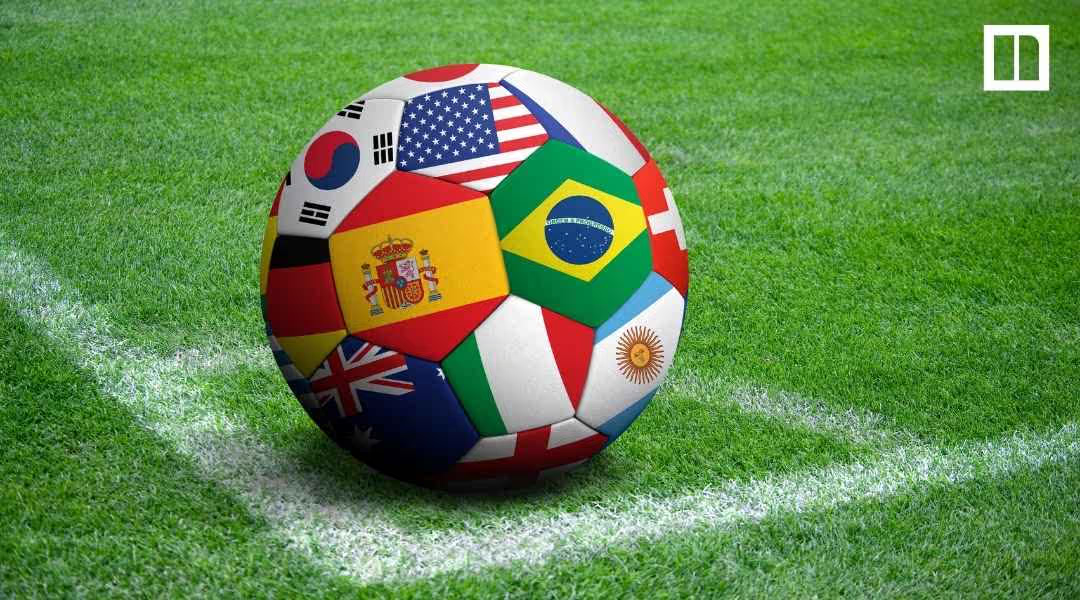
A soccer ball featuring various international flags—including Brazil, USA, Spain, and South Korea—sitting on the white corner line of a green grass soccer field.
May 11, 2026

The FIFA World Cup games capture the world's attention every four years. It’s a perfect time to bring that global excitement into your classroom. Whether you teach math, science, or ELA, soccer offers endless opportunities to hook your students with real-world connections.

You can use the tournament to dive into data analysis, explore population ratios, or practice evidence-based writing. These Newsela resources help you plan high-interest lessons without spending your entire weekend prepping. Let's look at how you can kick off these activities with your classes today.

[Analyze FIFA World Cup games data in STEM](id-sci)

Key Takeaways

  • Use real-world stats. Connect goals, player movement, and game data to math and science questions students can investigate.
  • Map the data. Let students compare teams, countries, or performance metrics visually before they explain what they notice.
  • Focus on decision-making. Use game moments to help students examine how athletes make fast choices under pressure.

Math and science aren’t just for textbooks. Make them come alive by incorporating the FIFA World Cup into your lessons. Help your students discover how data drives the game and use interactive tools to see how teams stack up globally.

Resources included in this lesson:

World Cup STEM resources

Use these resources to help students connect World Cup data, soccer science, and reaction time to STEM learning.

Resource Grade band Reading level/runtime
FIFA World Cup Data Set Tuva Dataset Interactive math 3–12
Science of Soccer Success Article 4–12 580L–1330L
Penalty Kick Reactions Article 4–8 490L–1260L

Scroll left to right to see the full table.

How can students use real-world data to analyze World Cup performance?

Hook students with the FIFA World Cup dataset. It’s interactive, so they can map out past wins and goals for themselves, making data literacy feel more like a game. Use these premade data drills to keep things simple for every grade level:

World Cup STEM prompts

Guide World Cup data discussions by grade band

Use these prompts to help students notice patterns, compare data displays, and explain what World Cup data can show.

Upper elementary: Grades 3–5
  • What do you notice about where FIFA teams are on the map?
  • Which countries have both men’s and women’s teams represented in the data?
  • How many total World Cup wins does the U.S. have if you combine the men’s and women’s teams?
  • Which continent has only one country represented in the data?
  • Compare the women’s U.S. team and Canada. Which team has scored more goals?
Middle school: Grades 6–8
  • What are two patterns you notice right away on the map?
  • Which continent has the most World Cup wins in the dataset?
  • Which team has scored the most goals in the dataset?
  • What relationship do you notice between the data points in the scatter plot?
  • When is a map more useful than a scatter plot for understanding this data?
High school: Grades 9–12
  • What evidence would you use to define “successful” in this dataset?
  • How would your conclusion change if you looked at goals, wins, or tournament appearances separately?
  • How does the dataset compare with official FIFA rankings?
  • What does the map make easier to understand than a table?
  • What information is harder to show clearly on a map?

What is the science behind soccer success on the field?

Soccer success is more than just practice. It’s also biology and physics. In addition to studying the FIFA World Cup dataset, have students read about the science of penalty kicks to understand human reaction times. It’s a simple way to meet STEM standards when discussing the tournament.

[Explore World Cup math ratios and population data](id-math)

Key Takeaways

  • Use ratios to compare scale. Have students compare population size with World Cup data so they can see why raw totals do not tell the full story.
  • Make population data concrete. Connect country size, team performance, and per-capita comparisons to help students reason through the numbers.
  • Organize comparisons before discussion. Use a simple three-column chart so students can track the country, population, and World Cup statistic they are comparing.

Students who love soccer know there are certain giants in the game, such as Brazil and Argentina. Then there are smaller countries like Cape Verde, a tiny island nation with fewer people than the state of Vermont. How can a country like that compete on the world stage?

Using math ratios helps your students see why their qualification is a huge deal. It’s the perfect way to bring real-world math into your classroom while focusing on a topic they already care about.

How do ratios help students understand underdog success?

It’s hard for students to grasp what population differences really look like without understanding the math behind them. When students calculate population-to-player ratios, they see the odds these athletes overcame to qualify. It makes the tournament’s “Cinderella stores” feel real and mathematically impressive.

What lesson steps guide students through soccer math?

You don’t need to spend your prep period building a World Cup lesson from scratch. This walkthrough gives you a lesson outline that you can use right away. 

Compelling Question

How can ratios help us compare countries’ World Cup rosters?

Spot the patterns

Read From Iceland to Cape Verde. Have students look for patterns in the population and geography data.

Calculate the ratio

Use the three-column chart to compare each country’s total population with a 26-player roster.

Graph the comparison

Use the model template to compare qualifier populations with Cape Verde’s population.

[Explore the power of sports in ELA lessons](id-ela)

Key Takeaways

  • Connect sports to students’ lives. Use World Cup stories to invite discussion about traditions, teamwork, competition, and community.
  • Practice evidence-based writing. Use the RACE writing strategy to help students organize claims, evidence, and explanations.
  • Use ready-made text sets. Choose texts with different reading levels and language options so students can engage with the same topic in different ways.

The World Cup isn’t just about sports. It’s also about people, connection, and pride. Use this activity to help your students see how games bring different cultures together. It’s a natural way to practice complex reading and writing, and meet the following aligned standards:

ELA standards alignment

CC.1.2.5.B

Cite textual evidence by quoting accurately from the text to explain what the text says explicitly and make inferences.

CC.1.5.5.A

Engage effectively in a range of collaborative discussions on grade-level topics and texts, building on others’ ideas and expressing their own clearly.

E05.B-K.1.1.1

Quote accurately from a text when explaining what the text says explicitly and when drawing inferences and/or making generalizations from the text.

How can sports help unify different cultures?

Sports give people a common language and shared experiences. Whether it’s a refugee team in California or a barrier-breaking golfer, these stories show students that “belonging” is a universal goal. 

Start with a quick discussion about your students’ favorite sports to get them talking. To build that understanding, use articles from the text set like:

World Cup ELA reading resources

Use these sports-themed texts to help students practice reading, discussion, and evidence-based writing through stories connected to athletes, teams, identity, and sports history.

Resource Grade band Reading level Spanish?
Belonging is the goal: Soccer unites refugees 4–12 450L–1000L
NASCAR’s first Arab American female driver 4–8 560L–1040L
Deaf America’s football team: Gallaudet Bison 4–8 620L–1160L
Opinion: Without Title IX... 4–8 1070L
Essay: Why sports history is American history 6–12 610L–1500L Yes
An IED made him blind. The pool gave focus 2–12 540L–1190L Yes
Women’s sports league: SheIS initiative 4–12 570L–1010L
Ann Gregory: Shattering barriers in golf 6–12 560L–1080L
The refugee who ran at the Olympics 2–5 380L–980L Yes

Scroll left to right to see the full table.

Why is the RACE strategy effective for analyzing sports articles?

Students may struggle to pull evidence from a text, but the RACE strategy provides a clear roadmap for doing so independently. Model the strategy once as a class using a shared article. Then, let your students pick their own article to read and use the annotation tool in Newsela to highlight their evidence in green. 

Start the discussion

Start with a quick discussion about sports in society. Use the Write-Pair-Share organizer to help students collect and compare ideas.

Find the evidence

Have students use the annotation tool to mark details they can use as text evidence.

Draft the response

Use the RACE strategy worksheet to help students organize their claim, evidence, and explanation.

Plan your FIFA World Cup Games lessons with Newsela

The FIFA World Cup games offer a unique chance to grab your students’ attention. With these ready-to-use Newsela STEM and Newsela ELA resources, you can bring the global tournament to life. Best of all? No heavy lifting or late-night planning required.

Not a Newsela customer yet? Sign up for an account to start your 45-day free trial. You’ll get access to all our premium, differentiated content and activities to finish the school year strong and head into summer learning with confidence.

Newsela Lite Hero Hands

Everything you need to accelerate learning across ELA, social studies, and science

Create your free Newsela account

If you like this article...

Browse more educational and seasonal content from Newsela.
A cinematic close-up of an American football resting on the turf of a stadium field, with yard lines stretching into a blurred background.
Blog

Get a Kick Out of Super Bowl Classroom Activities

Explore science, ELA, and social studies activities that will get your students excited about learning while tapping into their interest in the Super Bowl.

A close-up, action-oriented hero image of a basketball falling through an orange rim and a white net during a game. The background shows a blurred audience in a stadium setting, capturing the intensity of the NBA Finals.
Blog

NBA Finals Activities and Basketball Articles for Students

Use basketball articles for students to teach ELA, STEM, and social studies with engaging NBA content and real-world learning.

A close-up shot of a baseball with red stitching sitting on the white chalk line of a baseball field's infield dirt. The stadium seating is blurred in the background.
Blog

Baseball Activities for World Series Lessons

Bring the World Series into class with baseball activities for ELA, social studies, STEM, and math.

Related resources

Explore more in-depth content on the education topics that matter in your schools and classrooms.
No items found.

Inspire the desire to learn.

Ready to engage, support, and grow every learner?