
Products

 Products Overview
Newsela products are purpose-built to unlock student motivation, inspire teachers, and drive long-lasting learning outcomes.









Resources
About
Products OverviewNewsela products are purpose-built to unlock student motivation, inspire teachers, and drive long-lasting learning outcomes.
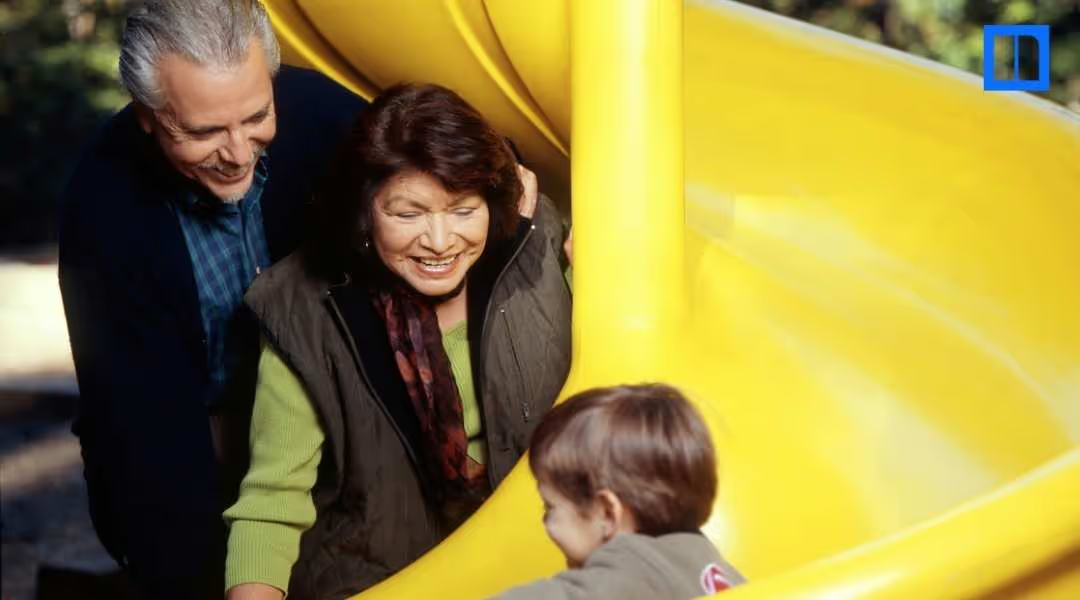
Grandparents Day activities for classroom teachers work when they give students more than a craft. The strongest lessons help students think about family roles, intergenerational relationships, and identity.
This year, National Grandparents Day falls on Sunday, September 13, but that doesn’t mean you can’t prep for it in the classroom! Use these ELA and STEM activities to connect the holiday to reading, discussion, and genetics without dropping in an extra disconnected seasonal lesson.
Use Grandparents Day to help students explore how family stories, memories, and relationships shape identity. These ELA activities give students flexible ways to access those ideas through short texts, poetry, and novels, while keeping the topic inclusive for different family structures.
Grandparents and grandparent figures often show students other aspects of family, memory, care, and identity they don’t get from other family members. For this Grandparents Day classroom activity, start with a low-pressure reflection that lets students think about a grandparent, another older relative, a family friend, or even a fictional grandparent character.
The choices matter because not every student has the same family structure or celebrates Grandparents Day. Giving students options keeps the focus on meaningful relationships rather than expected experiences.
A short poem gives students a shared text for talking about memory, aging, care, and connection.
Invite students to choose one poem from the family relationships collection and read it twice. On the first read, they can mark words or lines that show a relationship. On the second read, they can annotate what the speaker seems to feel about another person.
Then, ask students to answer a question with text evidence: How does this poem show the importance of relationships in someone’s life? They can discuss their answers in pairs or use the poem as a mentor text for writing their own creation about meaningful relationships.
Novels with grandparents as main characters or significant secondary characters can help students explore family relationships over time. These stories give students room to discuss identity, belonging, cultural traditions, and the ways older generations shape younger ones.
Use these Newsela ELA Novel Studies for independent reading recommendations, literature circles, or whole-class novel units. Each one gives students a different way to think about what grandparents and grandparent figures can represent in a story.
ELA novel and book studies
Use these Newsela ELA resources to help students explore how grandparents and grandparent figures shape character, conflict, identity, family history, and belonging.

Newsela ELA book study
Two brothers spend the summer with their grandparents. Their grandfather’s ideas about courage, fear, family, and growing up sit at the center of the story.
Open Newsela book resourcesNewsela ELA book study
Naomi and Owen are raised by their great-grandmother, Gram, who works to protect them and keep their family together.
Open Newsela book resourcesNewsela ELA book study
Nokomis lives with Omakayas’s family and serves as a grandmother, storyteller, cultural teacher, healer, and source of knowledge about the land.
Open Newsela book resourcesNewsela ELA book study
Jacqueline’s grandparents shape her childhood in South Carolina and influence her understanding of family, home, history, religion, race, and the South.
Open Newsela book resourcesNewsela ELA book study
Herman E. Calloway becomes a major figure in Bud’s search for family, and the revelation that he is Bud’s grandfather reframes their difficult relationship.
Open Newsela book resourcesNewsela ELA book study
Scoob and his grandmother, G’ma, are central to the story. Their road trip reveals family history, racism, segregation, and the barriers Scoob’s grandparents faced.
Open Newsela book resourcesNewsela ELA book study
Celia del Pino is both a grandmother and a central character whose relationship with Pilar connects three generations and Cuban and Cuban American perspectives.
Open Newsela book resources
Newsela ELA book study
The Tillerman children travel to find their grandmother, Abigail Tillerman, and the question of whether she will accept them drives the story.
Open Newsela book resourcesNewsela ELA book study
Yang’s grandmother is one of the memoir’s emotional centers and is described as someone who held the family together through war, refugee camps, and resettlement.
Open Newsela book resourcesNewsela ELA book study
Max’s grandfather, Buelo, is a mentor and storyteller whose stories help Max understand family, courage, and guardianship.
Open Newsela book resourcesNewsela ELA book study
Rose Lee lives with her sharecropper grandparents. Her relationship with Ma Pearl is painful and powerful, affecting Rose’s daily life, identity, and hopes.
Open Newsela book resourcesNewsela ELA book study
Sunja becomes the matriarch and grandmother of a four-generation family, making the novel useful for exploring how grandparents carry history across countries and generations.
Open Newsela book resourcesNewsela ELA book study
Sal travels across the country with Gram and Gramps, whose stories, humor, and presence shape the journey.
Open Newsela book resources
Newsela ELA book study
The unnamed boy’s grandmother raises him, protects him, teaches him about witches, and helps him act with courage.
Open Newsela book resourcesSTEM gives students another way to connect Grandparents Day to classroom learning. Start with hands-on gift projects that teach design and chemistry, then move into genetics lessons that help students examine inherited traits.
Students can make Grandparents Day gifts that double as STEM lessons. Instead of just making a craft, use these projects as a way for students to apply science and engineering ideas to something tangible they can give as a present to an important grandparent or grandparent figure in their lives.
Two classroom-friendly options are bath fizzers and recycled-material toolboxes. Bath fizzers can show students chemical reactions in action, while the toolbox project asks students to design and build a usable structure from everyday materials.
Bath fizzers are great Grandparents Day STEM activities because they let students make a small gift and explain the science behind it. The fizzing happens when baking soda and citric acid react after you add water. That reaction produces carbon dioxide, which creates the bubbles you see.
Have students make the bath fizzers using the instructions below, then pause before they wrap up the gift. Ask them to explain why the dry ingredients don’t react right away and why adding liquid too quickly could start the reaction before the fizzer is ready.
Then, connect the activity to a short reading about chemical changes, chemical reactions, or mixtures. Students can use the readings to add a science note to their gift or the gift tag.
Use this Grandparents Day gift project to help students make a bath fizzer and explain how water starts a chemical reaction between baking soda and citric acid.
Investigation question
Why does a bath fizzer bubble only after water is added?
Quick materials check
Build and explain
Have students follow Activity: Make a fizzy bath ball to combine the ingredients and press the mixture into a mold.
Before adding water, ask students why the dry baking soda and citric acid do not react right away.
Help students connect the bubbles to carbon dioxide produced when water starts the reaction between baking soda and citric acid.
Before students package the gift, have them write one sentence explaining the chemistry behind the fizz.
Pair it with Newsela readings
Use the activity for build instructions, then choose a reading to help students connect the project to chemical changes, chemical reactions, or mixtures.
| Resource | Reading Level | How to use it | Spanish? |
|---|---|---|---|
| Activity: Make a fizzy bath ball | Use this activity as the build instructions for the bath fizzer gift project. | ||
| What is a chemical change? | 550L–1110L | Use this reading to help students decide whether the bath fizzer shows evidence of a chemical change. | |
| What is a chemical reaction? | 500L–1180L | Use this reading to help students explain why the fizzing starts only after water is added. | |
| What is a mixture in science? | 390L–1190L | Use this reading to review how ingredients combine before students discuss when the reaction begins. | Yes |
Scroll left to right to see the full table.
A toolbox creation activity gives students a simple way to connect Grandparents Day gift-giving to engineering design. Instead of starting with a kit, students have to think about the materials they have and how each part of the structure should fit together.
Have students build a toolbox with recycled materials, then ask them to explain one design choice they made. For example, they might describe how they shaped the sides, attached the handle, or decorated the toolbox for the person receiving it.
Pair the build with a short reading about the engineering design process so students can connect the project to planning, building, testing, and revising.
Use this Grandparents Day gift project to help students repurpose recycled materials, design a simple structure, and explain how their design choices help the toolbox work.
Investigation question
How can recycled materials become a useful toolbox?
Quick materials check
Build and explain
Tell students they are engineering a toolbox from recycled materials for a grandparent, grandparent figure, or another important person.
Ask students to use the size of the shoe box to plan the sides, handle, and decorations before they build.
Have students follow Activity: Build a toolbox to assemble the toolbox and adjust their design as needed.
Before students give or display the toolbox, have them write one sentence explaining how one material or design choice helped the structure work.
Pair it with Newsela readings
Use the activity instructions and engineering design article together so students can connect the finished gift to the design process.
| Resource | Reading Level | How to use it |
|---|---|---|
| Activity: Build a toolbox | 630L | Use this activity as the build instructions for the recycled-material toolbox project. |
| The engineering design process | 430L–1040L | Use this reading to help students connect their project to planning, building, testing, and revising. |
On smaller screens, scroll sideways if needed to see the full table.
Genetics lessons can connect Grandparents Day to family traits, inheritance, and variation, but they need a thoughtful setup. Keep the focus on scientific patterns rather than asking students to compare themselves directly to relatives.
Start by asking: “Why don’t siblings always look exactly the same?” From there, students can read about Mendelian inheritance, dominant and recessive genes, and Punnet squares.
These resources also help you find a way to discuss inherited traits without assuming every student knows or is biologically related to the people they call their grandparents.
Grandparents Day activities for the classroom don’t have to stand alone as a holiday craft. When you connect the day to reading, discussion, and science, students get a meaningful way to explore relationships and family stories.
Use these Newsela Learning Suite resources to choose the path that fits your class best. Not a Newsela customer yet? You can create an account to start your free 45-day trial of our premium products.


Easy Mother’s Day student activities for your classroom. Use ELA and STEM lessons to build skills while students create meaningful gifts.

Skip the cheesy ties. Discover meaningful Father's Day activities for students that build literacy skills and celebrate every family dynamic.

Use these Hispanic Heritage Month lesson plans to help students explore authors, poetry, paired texts, and Hispanic culture in ELA.





.jpg)
.jpg)