Newsela launched in 2013 with a bold mission: Meaningful classroom learning for every student. Today, our team constantly strives to deliver powerful solutions that inspire our users.
The Fourth of July is more than fireworks and cookouts. For students in summer school, at summer camps, or who are practicing skills at home, it’s a chance to explore U.S. history and the way we understand the American identity.
Use these Fourth of July activities to bring ELA, social studies, and STEM into your units to cover these topics and to dive into the 250th anniversary of the United States in 2026!
Jump to
[Share Fourth of July social studies activities](id-ss)
Key Takeaways
●The history behind Independence Day. Have students read about the Declaration of Independence, the American Revolution, and the origins of the holiday.
●Different perspectives on freedom. Explore how ideas about freedom, citizenship, and American identity have changed over time and whose perspectives have shaped those conversations.
●Connections to local history. Use time capsules and oral history projects to help students explore how national events connect to the histories of their own communities.
Start with the history behind Independence Day. These Fourth of July social studies activities help students explore the Declaration of Independence, American identity, and the events that shaped the United States over the last 250 years.
Start with the history of Independence Day
We celebrate the Fourth of July to mark the adoption of the Declaration of Independence back in 1776. When students consider this document, they can ask questions about what independence means and who was included in America’s founding promises.
Use this text set to help students build background knowledge about the holiday and to compare and contrast media that present different views of American identity.
Explore the origins of Independence Day
Build background with a mix of videos, articles, fiction, poems, and speeches. Ask students to choose two resources and compare what each one shows about why Americans celebrate Independence Day and how people reflect on American identity.
Fourth of July social studies resources
Use these Newsela Social Studies resources to explore Independence Day history, celebrations, and different perspectives on freedom and American identity.
Founding documents and the American Revolution4 resources+
Founding documents and the American Revolution resources
As students explore, have them highlight details that explain why Americans celebrate Independence Day in one color. In another, ask them to highlight details that show how Americans celebrate. Then, ask them to annotate and explain what each resource suggests about American identity.
Compare why and how Americans celebrate today
After students explore the resources, ask them to move from facts to interpretation. They can use the evidence they uncovered while reading and watching to explain how Independence Day relates to ideas such as freedom and citizenship.
Annotation activity: Why and how Americans celebrate Independence Day
Have students choose two Fourth of July resources. As they read, watch, or view each one, have them use the following categories to highlight evidence and add annotations about Independence Day and American identity.
History
Why do Americans celebrate Independence Day?
Highlight historical events, ideas, or documents connected to the origins of Independence Day.
Traditions
How do Americans celebrate Independence Day?
Highlight traditions, reflections, and ways people observe the Fourth of July today.
Identity
What does American identity mean?
Annotate what each resource suggests about freedom, citizenship, equality, or national identity.
Discussion or writing prompt
Why and how do Americans continue to celebrate Independence Day today? Use evidence from both resources in your response.
Use a time capsule project to connect 1776 to 2026
A time capsule project gives students a concrete way to connect past, present, and future. They can explore key moments in American history and then create a class time capsule that captures life in 2026.
This activity is great for celebrating America’s 250th anniversary because it asks students to think beyond a single event. They’ll consider how history is remembered, what everyday objects can tell us, and what they hope future generations will understand about life today.
Explore key moments in American history
Before students build their own time capsules, have them explore moments that shaped the United States. Ask them to choose one or two resources from the time capsule text set to explore different eras. As they read, they should look for details that show what people may have valued, worried about, or wanted future generations to know.
Time capsule resources for America’s 250th anniversary
Have students explore events from different periods in U.S. history before choosing what they would include in a time capsule for 2026. Start with the time capsule guide, then use the historical resources to compare what changed over time.
Planning and early U.S. history10 resources+
Planning and early U.S. history time capsule resources
After students explore the past, have them plan a time capsule that captures life in 2026. You can make the capsule a class activity, invite students to make small individual capsules, or work on it as a community project. Each student will choose items that show what life is like now and why those items matter.
Time capsule planning checklist
Use this checklist to help students choose meaningful items, explain why they matter, and plan how to store their time capsule safely.
✓
Choose who the capsule represents.
Decide whether the capsule represents your class, school, family, community, or generation.
✓
Select 5–10 meaningful items.
Include items that show what life is like in 2026, such as student writing, drawings, photos, a class playlist, local event flyers, or a map of your city or state.
✓
Add a few 2026 artifacts.
Consider currency minted in 2026, a class photo or yearbook, a printed newspaper or magazine, Winter Olympics or sports championship memorabilia, or pop culture collectibles like Labubus or KPop Demon Hunters merchandise.
✓
Explain every choice.
For each item, have students describe what it is, why they chose it, and what someone in the future might learn from it.
✓
Keep unsafe items out.
Don't include food, liquids, batteries, sharp objects, breakable glass, or hazardous materials. Choose items that can be stored safely over time.
✓
Plan how to preserve it.
Label the capsule with the date, class, school or community, and intended opening date. Store or bury it only in a safe, approved place.
Write a letter to the future
After students choose their time capsule items, have them write a letter to the person or people who may open it in the future. This reflection helps them explain what life was like today, and what they hope people understand when the United States turns 300 in 2076.
Students can include their hopes for the future, the challenges they think the country could face, or their reasons for choosing their time capsule items. The letters can give future readers context they won’t get from objects alone.
Enter Newsela’s America at 250 Time Capsule Giveaway
Want some help taking this activity from the screen to your classroom? Enter our time capsule giveaway for a chance to win a kit that helps you and your students preserve memories from 2026. It’s easy to enter, and we have two more drawings before summer is over. Don’t miss your chance!
Explore Newsela's time capsule giveaway
Newsela celebrated America's 250th anniversary with a giveaway of three time capsule kits. Although the 2026 drawing dates have passed, you can still use the activity ideas to help students capture what life is like today.
How the giveaway worked
Teachers followed three steps to enter the 2026 giveaway. Use the first two steps to find resources and plan your own classroom time capsule project.
1Sign in to Newsela
Search for resources about America's 250-year history and choose content that fits your class, subject, and grade band.
2Assign an article
Choose an American history article that helps students explore the events, people, and ideas that have shaped the country over the past 250 years.
3Complete the entry form
During the promotion, teachers completed an entry form for a chance to win one of three time capsule kits.
The three scheduled drawings have passed, but the America 250 resource page is still available.
The promotion allowed teachers to enter once for eligibility in all three drawings. All scheduled drawing dates have passed.
Watch the time capsule giveaway overview
Get classroom ideas for connecting time capsules to ELA, social studies, and science while exploring America's 250th anniversary.
Check it out. It's big. It's shiny. It's waterproof. It's a time capsule. It's waiting to be filled by you and your students. We're celebrating America's semi quincentennial with the time capsule giveaway. And it's more than just a fun activity. It's a way to turn everyday teaching into something that is lasting, it's personal, it's unforgettable. What will your students put inside? ELA students, you might have them write a letter to their future selves, maybe analyze language changes over time. Maybe include a list of slang words that are current in twenty twenty six. For your social studies students, you might discuss current events, reflect on community, ask what will people in the future want to know about who we are right now. Science class, explore materials, preservation, maybe make predictions about what life will be like in the future. And it doesn't have to stop with one classroom. If you decide to use your time capsule for the entire school, maybe you'll have each grade vote and decide what represents them best. Maybe have different clubs provide something to go inside. You could include school newspapers, lunch menus, maybe team accomplishments. Time capsule is a snapshot of your school, your community in this exact moment, sealed and saved. All you have to do is log in to Newsela, choose an article that helps you teach two hundred fifty years of America, and assign it. From the signing of the Declaration of Independence to the recent Artemis mission, anything that helps your students reflect on this momentous moment counts. We'll be pulling three winners starting in May. So what will your students leave behind? Send the message forward in time from your classroom to the future.
This video was created for Newsela's 2026 giveaway, so its entry instructions and drawing references are historical.
Explore American identity with an oral history project
An oral history project helps students connect founding ideals to real voices in their community. Start by reading excerpts from our nation’s founding documents, and then have them interview people in their lives to answer the question: What does America mean today?
Run this activity across multiple days to allow students to draft questions, choose interview participants, and collect responses. Then, create a class “250 Voices of America” collection that shows how people’s ideas connect to or challenge the country’s founding ideals.
Analyze founding ideals
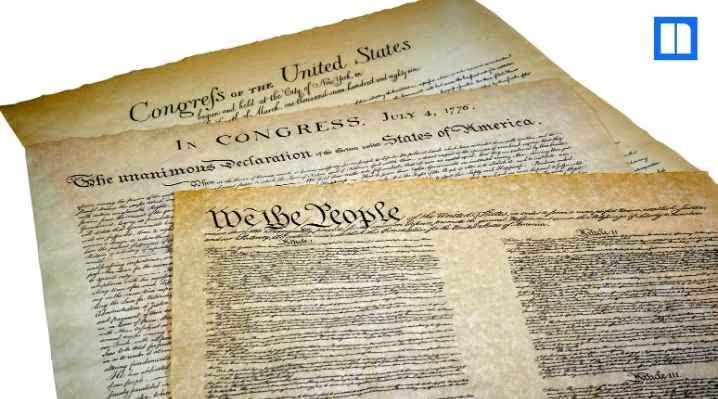
Start by giving students excerpts from the United States’ founding documents like “We the People,” “consent of the governed,” or “Life, Liberty, and the pursuit of Happiness.”
Then divide students into small groups and assign each group one founding document to explore. As they read, have students highlight key ideas and annotate examples of how those ideas affect life today.
Activity sequence: Analyze founding ideals
Help students explore the ideas in America's founding documents
before they begin the oral history project.
1
Warm-up
Write-pair-share
Write
What do these statements seem to be about? What kind
of country do these ideas describe?
Pair
What values or ideas do you notice? Do these ideas
feel important today?
Share
Do you think people today would agree on what
these statements mean? Why or why not?
2
Close reading
Read and annotate
Assign each student one founding document. As students
read, have them highlight key ideals and annotate examples
of how those ideas affect life today.
3
Collaborate
Teach the group
Have each student complete the Triad Jigsaw organizer,
teach their document to the group, and compare which
ideas appear across more than one text.
Group brainstorm
After the jigsaw, ask students: What ideas show up across
more than one document? Which idea might people today
have different opinions about?
Graphic organizer
Triad Jigsaw organizer
Students can capture a key idea from their assigned
document, explain what it says about America, and
share their findings with the group.
Next, have students draft open-ended interview questions that connect America today to the founding ideals they analyzed. The goal is to help students gather real perspectives from real people.
Then ask each student or small group to choose three to five people to interview. This might include:
Family members
School staff members
Neighbords
Community members
Before they begin, ask students to consider how they’ll collect responses, what information they’ll record, and how the class will combine everyone’s answers into a “250 Voices of America” collection.
Classroom planning activity
Oral history interview planner
Help students prepare interview questions, choose participants, and collect responses for a class “250 Voices of America” collection.
Focus question
What does America mean today?
Students should use this question as the anchor for their interviews and connect follow-up questions to founding ideals like freedom, equality, rights, and representation.
1 · Prepare
Draft open-ended questions
Have students write three to five questions that invite detailed responses.
Sample questions
What does freedom mean to you today?
Do you think America lives up to its founding ideals? Why or why not?
What rights feel most important to you?
2 · Connect
Choose interview participants
Ask students to identify three to five people they can realistically interview.
Possible participants
Family members
School staff
Neighbors
Community members
3 · Collect
Plan the response system
As a class, decide where responses will live and what information students should record.
Collection methods
Notebook
Shared doc
Google Form
Information to record
Name or initials
Age group
Responses
Reflect on what America means today
After students complete their interviews, bring the class back together to look for patterns. Students can compare interview responses with the founding ideals they studied earlier and ask where those ideas connect, stretch, or conflict with people’s lived experiences today.
Finally, build the “250 Voices of America” final product. This could take a variety of forms like:
Oral presentations
Slide decks
Word cloud
Wall display
Audio presentation
Video presentation
Oral history reflection checklist
Use this checklist to help students turn interview responses into a thoughtful final reflection or class “250 Voices of America” product.
✓
Share one powerful response.
Students choose one interview answer that surprised them, challenged their thinking, or clearly showed what America means to that person.
✓
Name the theme behind the response.
Students connect the response to a larger idea, such as freedom, opportunity, fairness, rights, responsibility, safety, belonging, or community.
✓
Connect the theme to a founding ideal.
Students explain how the response connects to, extends, or challenges an idea from a founding document.
✓
Add a class takeaway.
Students write one sentence that answers: What do these interviews teach us about what America means today?
What students can share
A quote or paraphrase
One interview response that captures a clear point of view.
A theme
The bigger idea they hear across one or more interviews.
A connection
How the response connects to a founding ideal or current issue.
A question
Something the interview made them wonder about America’s future.
Student reflection prompt
What does America mean today? Use interview responses and evidence from founding documents to explain what people’s answers reveal about American identity.
[Explore Fourth of July ELA activities](id-ela)
Key Takeaways
●Analyze the language of independence. Students can study how the Declaration of Independence presents ideas like natural rights, equality, and government by consent.
●Compare voices across genres. Speeches, poems, fiction, and nonfiction help students see how writers have described America in different ways.
●Turn close reading into discussion. Evidence-based prompts help students explain how authors build claims about freedom, identity, and belonging.
Help students examine what independence meant to writers, speakers, and communities across time. These Fourth of July ELA activities invite students to analyze primary sources and news articles about American identity.
Analyze the Declaration of Independence
The Declaration of Independence gives students a close look at the language and ideas that shaped the United States. For high school students, this text can support lessons on argument, rhetoric, word choice, and the connection between founding ideals and American identity.
Have students focus on the question, “How did the Declaration of Independence address the concepts of natural rights, equality, and government by consent?”
Build background before close reading
Before students analyze the Declaration of Independence, help them build context on the time period, the document's purpose, and the conflict between the Thirteen Colonies and Great Britain.
Have students respond to the question “What does independence mean to you?” They can respond orally, in writing, or by sharing in small groups. Then, have them watch a short video on the Declaration of Independence to prepare for reading the text.
Examine natural rights, equality, and government by consent
For the first read of the Declaration of Independence, have students highlight key sentences that show Thomas Jefferson’s main points. Ask them to add short annotations that restate those sentences in their own words.
On the second read, students can focus on three ideas that shaped the argument in the Declaration of Independence:
Natural rights
Equality
Government by consent
After they collect evidence, they can use the Evidence Conclusion worksheet to turn their notes into a discussion response or a paragraph.
Close-reading lens: Three ideas in the Declaration of Independence
Use this second-read lens to help students connect Jefferson’s language to the ideas behind independence.
Natural rights
What rights does the document say people should have?
Highlight lines that name or describe rights.
Equality
How does the document describe people’s status, worth, or shared humanity?
Annotate what Jefferson’s wording suggests.
Government by consent
What does the document say about where government gets its power?
Explain the idea in your own words.
Focus question
How did the Declaration of Independence address the concepts of natural rights, equality, and government by consent?
Compare the Declaration of Independence with “Common Sense”
After students analyze the Declaration of Independence, have them read excerpts from Thomas Paine’s “Common Sense.” Both texts come from the same historical period, but they use different language, structure, and appeals to make a case for independence.
Ask students to compare how each text addresses the three pillars of natural rights, equality, and government by consent. Then, have them decide which text they find more persuasive or powerful and support their answer with evidence from both sources.
Comparison activity: Two arguments for independence
Use this activity to help students compare how the Declaration of Independence and Thomas Paine’s “Common Sense” make arguments for independence.
Text 1
The Declaration of Independence
Students examine how Jefferson uses formal claims, listed grievances, and founding principles to justify independence from Great Britain.
Use these questions to examine both texts. Students can record evidence and observations in the Paired Texts organizer.
Natural rights
What rights or freedoms does each text say people should have?
Equality
How does each text describe people’s status, worth, or relationship to power?
Government by consent
What does each text suggest about where government gets its authority?
Student decision prompt
Which text makes the stronger argument?
After comparing both texts, students should choose which one they find more persuasive or powerful. Their response should include evidence from both texts and explain how the author’s language, structure, or reasoning shaped their decision.
Use Fourth of July texts across grade levels
You can also use Fourth of July ELA resources beyond the Declaration of Independence lesson. Newsela ELA includes short texts for younger students, patriotic holiday comparisons for upper elementary and middle school, and speeches and poems for high school close reading.
You can use text sets to match activities to your grade band and instructional goal.
Fourth of July ELA resources
Use these Newsela ELA resources to help students read, compare, and analyze texts connected to Independence Day, patriotic holidays, war, and American identity.
On smaller screens, scroll sideways to view the full resource table.
Compare how poets develop different views of America through language, imagery, and theme.
[Try Fourth of July STEM activities](id-sci)
Key Takeaways
●Make science visible. Students can watch color move through flower stems to explore capillary action and plant structures.
●Connect holiday fun to STEM vocabulary. Seasonal activities give students a concrete way to discuss density, buoyancy, transpiration, and observation.
●Pair experiments with reading. Newsela STEM resources help students connect each activity to articles, infographics, and explanations of the science behind it.
Bring seasonal science into your Fourth of July activities with hands-on experiments that students can connect to real STEM concepts. These activities help students explore plant science, capillary action, density, and buoyancy with simple materials.
Color your own Fourth of July flowers
Students can create red, white, and blue flowers while exploring how water moves through plants. This Fourth of July STEM activity makes capillary action visible. As water moves up the stem, the food coloring travels with it, changing the color of the petals.
After the experiment, students can connect their observations to plant structures and transpiration.
Gather the materials
For this activity, you can use simple, common household materials to create red, white, and blue flowers. This activity does include a knife or sharp scissors, so practice science safety while working. You can always cut the flower stems while students complete other parts of the experiment.
Materials for Fourth of July flowers
Gather these supplies before students start the capillary action experiment.
2 glass cups or mason jars
Warm water
Red and blue food coloring
White-petaled flowers, such as chrysanthemums, carnations, or daisies
Knife for adult use
Run the capillary action experiment
Set up the flower experiment so students can observe changes over time. Have them make one-color flowers first, then compare them with split-stem flowers that pull in two colors at once.
For self-contained or longer classes, have students check the flowers every 30 minutes and record what changes they notice. Leave the flowers overnight and have them observe how color moves through the stem and into the petals the next day.
How to color your own Fourth of July flowers
Use this simple experiment flow to help students observe how water and color move through flower stems.
1
Prepare the colored water
Fill each cup with about 2 inches of warm water. Add red food coloring to one cup and blue food coloring to the other until each color is dark.
2
Make one-color flowers
Place some white-petaled flowers into each cup. Save a few flowers for the multicolor setup.
3
Create multicolor flowers
Have an adult carefully split a flower stem down the middle, leaving about 2 inches of stem intact near the flower. Place one half of the stem in red water and the other half in blue water.
4
Wait and watch
Ask students to check the flowers every 30 minutes and record what they notice. Leave the flowers overnight to observe more color change.
Connect the activity to plant science
After students observe the color change, connect what they saw to the science behind the experiment. Since the flowers are cut, the stems take in water instead of the roots. As water evaporates from the petals and leaves, more water moves through the plant to replace it. That movement is capillary action, and the food coloring travels with the water.
Students can use Newsela STEM resources to learn more about plant anatomy and life cycles before or after the experiment to better understand why it works.
Plant science resources for Fourth of July flowers
Pair the flower-coloring activity with resources about plant
structures and life cycles to help students explain how
colored water moves through a flower.
Create a layered red, white, and blue drink to explore density. In this Fourth of July STEM activity, different drinks remain layered because each liquid has a different sugar content.
The drink with the most sugar is the densest, so it settles at the bottom, and the ones with less sugar layer on top. Students can connect what they see to density, buoyancy, and how scientists explain why materials separate or mix.
Gather the materials
Use cold drinks with different sugar amounts for this activity so students can build their red, white, and blue layers. Choosing drinks with the right sugar content matters most because it changes each liquid’s density.
Be sure to review your classroom allergies and your school’s food or drink policies before doing this experiment, since it’s an edible one!
Materials for patriotic density drinks
Gather these supplies before students build a layered
red, white, and blue drink.
Drinking glass
Ice
High-sugar red juice
Medium-sugar white drink
Low-sugar blue drink
Build the layered density drink
Construct the drink one layer at a time. The order of the liquids matters. The drink with the most sugar goes in first, then the medium-sugar drink, and the lowest-sugar drink last.
Have students pour slowly and observe what happens between each layer. If the colors mix, ask them to consider factors such as the drink's temperature, how quickly they poured, or which liquid they poured first.
How to build a patriotic density drink
Have students layer drinks with different sugar amounts
to observe how liquids with different densities behave.
1
Refrigerate the drinks
Chill the drinks before the activity so warm liquids
don't melt the ice and make the layers harder to see.
2
Fill the glass with ice
Fill the glass about three-fourths full with ice to
slow the pour and help the liquids form layers.
3
Add the red juice
Pour the high-sugar red juice into the glass until
it's about one-third full to form the bottom layer.
4
Add the white drink
Slowly pour the medium-sugar white drink over the
ice or down the inside of the glass until it's
about two-thirds full.
5
Add the blue drink
Using the same slow pouring method, add the
low-sugar blue drink until the glass is almost full.
6
Observe the layers
Ask students to describe what happened to the
three liquids and explain why they think the
drinks stayed separated.
Connect the activity to density and buoyancy
After students complete the experiment, have them connect the results to the science. They can use Newsela STEM resources to learn more about density, buoyancy, and why some materials float, sink, separate, or mix.
Density resources for patriotic drinks
After students layer the drinks, use the article and
infographic to discuss density and why some liquids
float above others.
Bill of Rights Day: Classroom Lessons for History and ELA
Celebrate Bill of Rights Day with engaging ELA and social studies lessons that help students explore U.S. history, government, and foundational freedoms.
Fourth of July Activities for Every SubjectFind Fourth of July activities for ELA, social studies, and STEM that help students explore U.S. history, identity, and seasonal science.Oct 08, 2026Oct 08, 2026https://cdn.prod.website-files.com/66f182e7ce15762d01b32e09/67f6a57adacad483a903341b_67489f12c450bfcc11747e84_Fourth-of-July-Lesson-Plans-to-Spark-Interest-in-History-hero.avifhttps://cdn.prod.website-files.com/66f182e7ce15762d01b32e09/67f6a57adacad483a903341b_67489f12c450bfcc11747e84_Fourth-of-July-Lesson-Plans-to-Spark-Interest-in-History-hero.avifChristy Walters
















.jpg)
.jpg)