How To Bring Local History Into Your Classroom

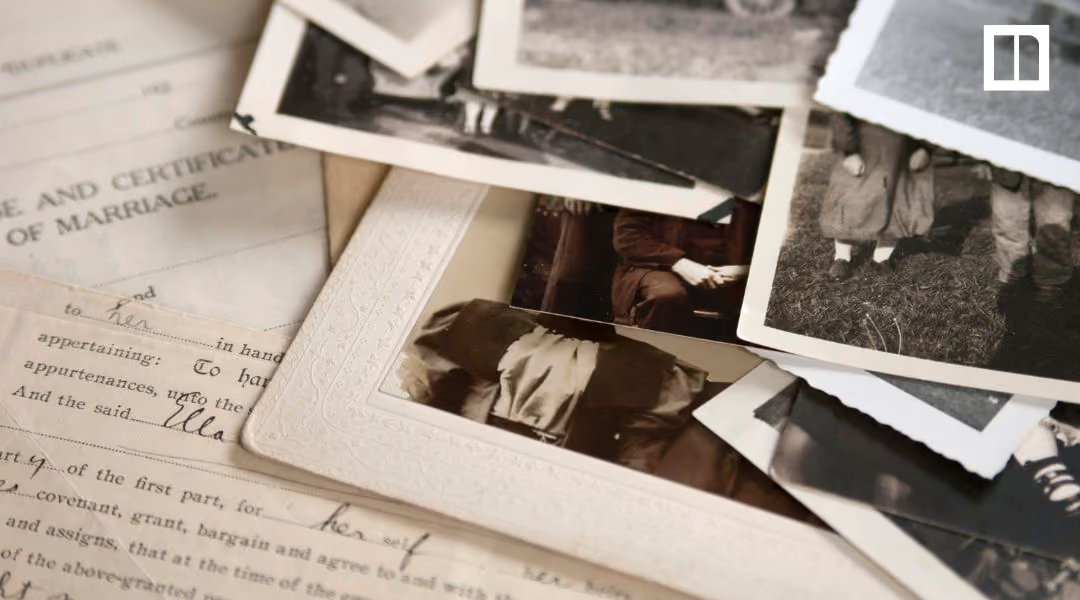
Vintage family photos and historical documents spread across a table.
June 25, 2026

Local history helps students see that historical events didn’t just happen somewhere else. It happened in places they know and spend time. Understanding this concept can help students realize that history, as one of my high school teachers used to say, isn’t just a bunch of boring old dead guys. 

You don’t need to build a full local history course to make the connections either. With the right questions, a focused set of sources, and a clear link to your standards, local history can fit right into the social studies lessons you already teach—for any grade band. 

[What is local history, and why does it matter?](id-what)

Local history is the study of people, places, events, and changes that shaped a community. Studying it helps students see that history didn’t just happen in faraway places as described in their textbooks. It actually happened in nearby locations that they see or visit every day.

Local history also helps students connect smaller stories to bigger historical themes. For example, if you have or had a mill or factory in town, that can connect to industrialization. Your neighborhoods may connect to immigration or migration patterns.

When students study local history, they’re not just learning names and dates from their own community. They’re learning how national and global events shaped real places, and how people in those communities shaped history, too.

[Why teach local history?](id-why)

Key Takeaways

  • Local connections make history concrete. Students can better understand big ideas when they see how those ideas shaped familiar places.
  • Local sources build historical thinking. Maps, photos, records, and community stories give students real evidence to question, compare, and explain.
  • Local history can reach beyond social studies. Community stories can connect to ELA, science, STEM, art, music, and civic learning.

Local history gives students a way to connect social studies to places they know. It gives them the chance to investigate how big events, moments, and decisions shaped their own communities.

It also gives you a practical way to build inquiry into the lessons you already teach. Students can ask questions, analyze sources, compare perspectives, and make evidence-based claims using examples from their hometowns. 

Help students connect big ideas to familiar places

Local history encourages students to think about what life in their towns or cities was like in the past. For example, the French and Indian War or the Civil War might feel dated or unimportant to students, but how would they feel if they knew the battles happened right in their town?

When students realize that their towns and cities have a past and may even be connected to key moments in history, social studies can become much more interesting.

Support historical thinking skills

Local history gives students a practical way to build the skills they already need to learn in social studies. It encourages them to evaluate sources, study changes over time, and analyze cause and effect.

It also helps students see that history connects to sources, not just retold stories in a textbook. Maps, photos, newspaper articles, or historical markers all pose questions and invite investigations.

Make social studies feel more relevant

Local history can help students see social studies as something connected to their lives. Digging into their hometown’s past might encourage them to ask and research questions like:

  • Who is this road, school, park, or neighborhood named after?
  • What used to be where our school stands now?
  • Who is represented in local monuments or memorials, and who’s missing?
  • How did a national event change life here?

Questions like these make history feel active. Students aren’t just memorizing dates and facts. They’re learning how to investigate the places, people, and decisions that shaped their community.

Connect social studies to other subjects

Local history can also help students make connections across subjects. In science or STEM, students might explore how local climate, waterways, or native species shaped community development. They might also research scientists, inventors, or innovations from their region.

In ELA, students can read works from local authors or poets, speeches, oral histories, or newspaper archives. In art or music, they might study local artists, public art, architecture, or music scenes.

These connections help students see that local history isn’t limited to one class or subject area. It’s a way to study how people, places, and culture shape each other over time.

[How can you work local history into an existing lesson?](id-how)

Key Takeaways

  • Use local history as a lens. One community example can help students connect required content to places they know.
  • Keep the inquiry focused. A strong local history lesson can start with one question, a few sources, and one evidence-based response.
  • Match the format to your time. Local history can work as a quick hook, short mini-inquiry, longer project, or recurring unit connection.

You don’t need to build a separate unit to teach local history. Start with a lesson you already teach, then add one local question, source set, or example to help students connect learning targets to a familiar context.

Use local history as a lens

You don’t have to pause your existing curriculum to teach local history. Instead, use it as a lens for the topics you’re already teaching.

For example, during a unit on industrialization, you might bring up a local mill, railroad, mine, or factory and discuss how it likely worked or operated during the industrial boom. This approach helps students see how larger historical developments shaped their communities. It also keeps the lesson focused on the broader concept, not just a collection of local facts.

Connect the lesson to your standards

To keep local history from feeling like an add-on to your lesson, connect it to a standard or skill you already need students to practice. This is a way to use local evidence to study larger historical ideas.

A local history investigation can support skills such as source evaluation, geographic reasoning, and cause-and-effect reasoning. For example, students might use maps, photographs, or public records to answer a standards-aligned question like, “How did a required historical development show up in our community?”

This approach keeps the lesson tied to your required content while giving students a more concrete way to investigate it.

Start with one question and a small source set

A local history lesson is easier to plan when you keep the inquiry focused. Start with one question students can answer using evidence from a few sources, then build one short task around that question.

Instead of sending students into a full archive, give them three to five sources that show different pieces of the story. Then ask them to use the evidence to make a claim, create a product, or explain what changed over time. 

Lesson flow: Local history mini-inquiry

Use this simple sequence to turn one local question into a focused evidence-based task.

Choose one question

Ask a question students can answer with evidence from a local place, event, person, or change over time.

Gather a small source set

Select three to five sources, such as a map, photo, article, oral history excerpt, or public record.

Model source analysis

Show students how to notice who created the source, what it shows, and what questions it raises.

Build an evidence-based response

Have students use source details to write a claim, annotate a map, revise a marker, or create a short exhibit panel.

Share the takeaway

Ask students to explain what the local example reveals about the larger historical topic.

Choose a format that fits your allotted time

Local history lessons can be as small or as large as your schedule allows. You might use a local history example to introduce a broader topic, or build in a longer project where students research a community question and share what they learn.

A recurring local lens can also work well. Instead of teaching a single local history lesson, students revisit a local example through units on topics such as migration, industrialization, civil rights, and civic life. 

Mini lesson planner

Plan a local history lesson at the right size

Use this quick planner to scale a local history activity for one class period, a short inquiry, a longer project, or a recurring unit connection.

Goal

Help students connect one local place, event, person, or change over time to the larger topic you’re already teaching.

Materials
  • One local history question
  • Three to five short sources
  • A place for students to record evidence
  • One final response format
Setup

Choose a local example that connects to the unit topic, then narrow it to a question students can answer with the sources you provide.

Pacing
  • 20–45 minutes: Use one source or question as a local history hook.
  • 2–3 class periods: Build a mini-inquiry with a small source set.
  • 1–2 weeks: Have students research and create a public history product.
  • One case per unit: Revisit local examples throughout the year.
Student task

Students analyze the sources, pull evidence, and explain what the local example shows about the larger historical topic.

Wrap-up

Ask students to share one claim, one piece of evidence, and one question they still have about the local story.

Teacher tip: Start with the smallest version that fits your schedule. You can always turn a strong hook into a mini-inquiry or project later.

[What are some simple local history lesson ideas?](id-ideas)

Key Takeaways

  • Concrete places spark inquiry. Students can begin with a school, street, park, landmark, or neighborhood and build historical questions from there.
  • Then-and-now sources make change visible. Maps, photos, articles, and records help students compare what changed, what stayed the same, and why.
  • Public history products give students purpose. Projects like exhibit panels, podcasts, maps, or marker rewrites help students share evidence with an audience.

Local history lessons work best when students can investigate specifics. Whether they’re looking at a place, source, or question, you want to give them something interesting to dig into. Start small, then choose an activity that helps them connect local evidence to the larger topics you’re already teaching.

Investigate a local place

Start with a place students can picture, like their school, a monument, or a business district. Then, turn that place into a question students can investigate. You may ask questions like:

  • Why does this place have its name?
  • What used to be here?
  • Who built, used, changed, or preserved this place?
  • How has this place changed over time?
  • What does this place reveal about a broader historical event or theme?

These questions keep the lesson grounded in a specific topic. Students don’t start with a long list of names or dates, but with a visible clue that ties the past to the present. Then they can use the evidence to figure out what it tells them.

Compare then-and-now sources

Then-and-now comparisons help students see change over time. Pair an older source with a current one, and ask students to look for:

  • What changed.
  • What stayed the same.
  • What might explain the difference.
Source comparison

Use then-and-now sources to study change over time

Have students compare an older source with a current source, then use evidence from both to explain what changed and why it may have changed.

Place
Older source

What buildings, roads, landmarks, boundaries, or natural features do students notice?

Current source

What looks different now? What stayed in the same place?

People
Older source

Who appears in the source? Who seems to have power, access, or visibility?

Current source

Who appears now? Whose experiences may still be missing?

Purpose
Older source

Why might this place, record, image, or map have been created?

Current source

How is this place or source used, remembered, or explained today?

Evidence
Older source

What details help students describe the past?

Current source

What details help students explain change, continuity, or unanswered questions?

Student task: Write one claim about what changed over time and support it with evidence from both sources.

Create a public history project

A public history project gives students a reason to turn their research into something their community can use. Instead of writing for just their teachers, you might encourage them to create something for a school display, museum, library, or local organization.

Projects can stay small, with options like an annotated map, a short podcast, or a community timeline. 

Student menu: Public history project options

Have students choose one way to share what their local sources reveal about the community.

Choose one product

Annotated map Mark important local places and explain what each one shows about the historical topic.
Museum label Write a short label that explains one source, artifact, photo, or place for a public audience.
Historical marker rewrite Revise a marker or plaque to include stronger evidence, clearer context, or missing perspectives.
Short podcast Record a brief audio segment that tells the local story using evidence from your sources.
Digital exhibit Arrange sources, captions, and a claim into a simple online or slide-based exhibit.
Community timeline Show how a local place, issue, or group changed over time using source-based entries.

Try a field trip alternative

You don’t have to leave campus to make local history come to life. If transportation, funding, or scheduling are a barrier to getting out into the community for a field trip, treat “place” as evidence that students can study in different ways.

Choice board: Local history field trip alternatives

Use one of these options when students can study a local place without leaving campus.

Choose one place-based activity

School walk Take a supervised walk around the school building or grounds and look for clues about the community’s past.
Name research Research a street, school, park, building, or neighborhood name and explain what that name reveals.
Map comparison Compare a historic map with a current map to see how roads, neighborhoods, waterways, or landmarks changed.
Then-and-now photos Analyze older and current photos of the same place and write a claim about what changed over time.
Virtual archive visit Explore a digital museum, library, archive, or historical society collection connected to the local topic.
Expert video call Invite a librarian, archivist, historian, museum educator, or community member to answer student questions.
School archive search Use yearbooks, newsletters, newspapers, cornerstones, photos, or school records to investigate a local question.
Digital site map Create a map of places students cannot visit in person and add notes, sources, or questions for each stop.

Teacher tip: Pair any in-person option with a source-based or virtual option so every student can complete the same kind of historical thinking task.

[How can you include difficult or overlooked local histories in your lessons?](id-sensitive)

Key Takeaways

  • Evidence keeps the lesson grounded. Students can study difficult local history through sources, context, and careful claims.
  • Multiple perspectives make the story fuller. Pair official records with first-person or community-created sources when possible.
  • Specificity matters. Teach about specific people, communities, Native nations, places, laws, and institutions instead of broad generalizations.

Local history can include topics that are sensitive, contested, or missing from the version of the story students usually hear. You don’t have to skip hard topics when you’re teaching local history, but you need lessons with clear context, careful source selection, and a focus on evidence rather than opinions.

Ground the lesson in evidence

Difficult local history can bring up strong feelings in the classroom. Keep the lesson focused on historical inquiry: What happened? What evidence do we have? Whose perspectives are included? 

This line of thinking may help students separate past actions from personal feelings to dig to the root of a cause or event, rather than how it makes them feel today.

Lesson flow: Evidence-based local history inquiry

Use this sequence to help students study difficult local history with context, sources, and supported conclusions.

Set the context

Give students the background they need to understand the time, place, people, and institutions involved.

Name the inquiry question

Frame the lesson around a question students can investigate with evidence.

Examine varied sources

Include sources from affected people, community members, institutions, and decision-makers.

Sort claims and interpretations

Help students separate what the source says, what it suggests, and what still needs corroboration.

Require evidence

Ask students to support conclusions with source details instead of opinion or assumption.

Connect with care

Discuss present-day connections only after students understand the historical record.

Include multiple perspectives

Overlooked histories often occur because certain sources were preserved while others were not, or because some voices were treated as “official.” To cover these types of histories in class, try pairing institutional records with first-person or community-created sources when possible.

For example, students might compare city-planning records with resident interview records, school-board minutes with student newspapers, or business records with labor and neighborhood sources. This helps them see how laws, education, or employment shaped different experiences in the same community.

Be specific

When you’re teaching overlooked local histories, specificity matters. Help students name the people, communities, and Native nations they’re studying. 

Use the checklist below to keep the lesson grounded in specific histories instead of broad generalizations.

Teacher look-fors: Specific local history lessons

Use this checklist to make sure students study specific people, places, sources, and contexts—not broad or generic versions of local history.

  • Name the specific community. Identify the people, Native nations, neighborhoods, organizations, or groups connected to the local story.
  • Use community-connected sources. Look for official Tribal, intertribal, cultural-center, education-department, local archive, or community-created sources when possible.
  • Place the story in context. Help students connect the local example to specific laws, institutions, land ownership, schools, labor, housing, voting access, or public memory.
  • Teach continuity into the present. Avoid treating communities only as part of the past. Include contemporary Native life, sovereignty, and present-day community connections when relevant.
  • Use land acknowledgments as a starting point. Let a land acknowledgment lead to deeper research, relationships, and source-based learning—not stand in for the whole lesson.

[Where can you find reliable local history sources?](id-sources)

Key Takeaways

  • Start close to the community. Libraries, archives, museums, Tribal nation websites, cultural centers, and school records can help students find local evidence.
  • Use national repositories for wider context. Larger collections can help you search by town, county, landmark, organization, event, or person.
  • Teach students to question every source. Markers, photos, articles, maps, interviews, and records all need context and corroboration.

Reliable local history sources can come from more than one place. Start close to the community, then expand your search to larger collections when you need more context, examples, or source types. 

Explore the community

Start with sources closest to the place students are studying. Local and community-based sources can help students investigate everyday life, community change, and overlooked stories—not just major events.

Local history source starting points

Use these source categories to build a focused packet of evidence before students begin their local history inquiry.

Official community sources

Look for: Tribal nation websites, municipal archives, county records, school archives, planning departments, and public-library special collections.

Use when: Students need records connected to local government, schools, land use, community decisions, or public services.

Local collecting institutions

Look for: Historical societies, museums, universities, religious institutions, labor organizations, libraries, and cultural centers.

Use when: Students need community-preserved materials, exhibits, oral histories, artifacts, or records that may not appear in government archives.

Digitized local records

Look for: Local newspapers, city directories, census records, property maps, meeting minutes, photographs, advertisements, oral histories, and legal documents.

Use when: Students need to compare change over time, study daily life, or trace how one place, issue, or group appears across different records.

Community-created sources

Look for: Student newspapers, resident interviews, neighborhood newsletters, organization records, family stories, local podcasts, community websites, and oral histories.

Use when: Students need perspectives that may be missing from official records or public-facing historical accounts.

Teacher tip: Pair official records with community-created sources when you can. For example, students might compare school-board minutes with student newspapers or city-planning records with resident interviews.

Use national repositories

When local sources are hard to find, national repositories can help you widen the search. Many let you explore by town, landmark, event, organization, or person of interest. 

These collections can also help students compare a local story to a larger historical pattern.

Research starting points

National repositories for local history source searches

Use these repositories when you need broader context, digitized sources, or teacher-ready materials connected to a local history question.

Repository Look for Try searching
Library of Congress Primary sources, maps, photographs, newspapers, recordings, teacher materials, and analysis tools. Town, county, neighborhood, landmark, event, person, or local newspaper title.
National Archives Government records, photographs, maps, letters, military records, census-related materials, and document analysis guides. County, federal program, court case, school, military site, agency, or historical event.
Smithsonian Learning Lab Curated collections, images, objects, museum resources, and learning materials connected to history and culture. Place name, community group, cultural topic, museum object, artist, movement, or event.
National Park Service Place-based history, historic sites, lesson materials, maps, preservation resources, and public history context. Historic site, region, landmark, battle, migration route, civil rights site, or environmental location.

Scroll left to right to see the full table.

Help students evaluate every source

Teach students that a local history source is evidence, not undeniable truth. A historical marker, family story, or newspaper article are just a few examples of sources that can help students understand the past, but they need context.

Students should ask who created the source, what it shows or leaves out, and what other evidence can confirm or deny in the story.

Student self-check: Evaluating a local history source

Use these questions before students decide what a source proves, suggests, or leaves unanswered.

  • Identify the creator. Name who created the source and what they may have known from their position or experience.
  • Check the purpose and audience. Explain when the source was created, why it may have been created, and who it was meant to reach.
  • Look for limits. Notice what the source does not show, whose perspective is missing, or what details may need more context.
  • Confirm important details. Compare the source with at least one other independent source before treating a claim as reliable.
  • Explain uncertainty. If the evidence conflicts or feels incomplete, describe the disagreement instead of forcing a final answer.

[How to use Newsela Social Studies to plan local history lessons](id-newsela)

Key Takeaways

  • Discovering My State supports community-based inquiry. Students can investigate state and community needs, then build a project around possible solutions.
  • Virtual Vacations can make place-based learning easier. Students can explore state capitals, landmarks, memorials, museums, and other local history connections through text sets and maps.
  • State Social Studies Editions help with standards alignment. State-specific collections can help teachers connect local and state history to required standards and inquiry-based instruction.

Newsela Social Studies can help you connect local history to the topics, standards, and inquiry skills you already teach. Use state-specific collections, place-based text sets, and scaffolded resources to help students explore how history connects to their communities.

Explore state and local connections with Discovering My State

The Discovering My State Collection can help students connect state history, community needs, and civic action. It’s My State, My Community units pair with each state and ask students to investigate issues in their local communities. Beyond investigations, they can brainstorm possible solutions and create a community action project presentation.

Plan a community action project

Use Discovering My State and the My State, My Community project plan to help students investigate community needs and propose solutions.

Collection

Discovering My State

Explore state and community connections through texts that help students think about local needs, resources, and solutions.

Explore the collection

Project plan

My State, My Community project plan

Guide students through researching a community issue and creating a presentation about what should be improved or promoted.

Download project plan

Project focus

Essential questions students can investigate

  • How can I make my community a better place?
  • What resources is our community lacking?
  • How can I help educate my community to better support community members?

Use Virtual Vacations for place-based learning

Newsela’s Virtual Vacations text sets can help students explore place-based history without needing a traditional field trip. Each text set includes articles about key figures, issues, or places in a state capital, along with a Google Map students can use to explore monuments, memorials, museums, or other locations.

Check out the Washington, D.C./Arlington, VA Virtual Vacation to see how it can become a local history source set. Students can choose a site to “visit,” read the connected Newsela resource, and explain how that place helps the community remember people, events, and public decisions.

Virtual Vacation example

Washington, D.C. and Arlington, Virginia local history resources

Use this Washington, D.C. text set, map, and resource list to help students connect specific places to public memory, government, war, civil rights, and community history.

Location Local history connection Newsela resource Reading level Grades
Vietnam Veterans Memorial Honors U.S. service members who served in the Vietnam War and includes the names of those who died or remain missing. Article: Architect and artist Maya Lin designed the Vietnam Veterans Memorial 560L–1280L 6–12
Arlington National Cemetery Established in 1864 during the Civil War and one of two national cemeteries maintained by the U.S. Army. Article: Arlington Cemetery wants to change the rules on who can be buried there 590L–1370L 6–12
The White House Official residence and workplace of the president, used by every U.S. president since John Adams. Article: The history of the White House 430L–1240L 6–12
Petersen House Known as the place where President Abraham Lincoln died after being shot at Ford’s Theatre. Article: Time Machine (1865) – The Assassination of Abraham Lincoln 680L–1160L 6–12
United States Holocaust Memorial Museum The United States’ official memorial to the Holocaust, with artifacts, archival documents, photographs, and survivor records. Article: Holocaust project focuses on what Americans knew and when 590L–1320L 6–12
Martin Luther King, Jr. Memorial Includes the “Stone of Hope” statue and is the first memorial for a Black American on or near the National Mall. Primary Source: Martin Luther King’s “I Have a Dream” speech 470L–1190L 6–12
Capitol Hill Home to the United States Capitol, the seat of the U.S. Congress and a National Historic Landmark. Article: Lawmakers at the Capitol 740L 2–3
National Museum of African American History and Culture A Smithsonian museum and the world’s largest museum dedicated to Black history and culture. Article: Why King’s right-hand man, Rustin, was nearly written out of history 590L–1190L 9–12
Clara Barton Missing Soldiers Office Commemorates the office Barton created after the Civil War to document missing and dead soldiers. Profile: Women Leaders–Clara Barton 440L–1090L 6–12
National Native American Veterans Memorial Recognizes the service of Indigenous military members across U.S. military branches. Article: Native American veterans receive a place of their own to reflect and heal 590L–1390L 4–12

Scroll left to right to see the full table.

Support standards alignment with State Social Studies Editions

Newsela Social Studies includes state-specific collections and instructional resources that can help you connect local and state history to required standards. These collections are built to support state frameworks, mandates, and initiatives while giving students access to the resources and learning materials they need. 

You can use State Social Studies Editions to find a local or state connection that fits the unit you’re already teaching. For example, some collections focus on state history, while others support Indigenous studies, civics, or other state-required topics.

State-specific resources

Newsela State Social Studies Editions

Use these state-specific collections to find standards-aligned local, state, civics, Indigenous studies, and mandate-connected resources for your classroom.

State What the collection supports State guide
Alabama State history content aligned to Alabama’s 3rd-grade state history standards, with instructional resources for young learners. Open guide
Arizona Indigenous studies content focused on historical and present-day experiences of Indigenous people in Arizona and the United States. Open guide
California Elementary social studies content and instructional resources for 4th- and 5th-grade instruction aligned to the California Social Studies Framework. Open guide
Colorado Indigenous studies content focused on historical and contemporary experiences of Indigenous people in Colorado and the United States. Open guide
Connecticut Black and Latino studies content that complements Connecticut’s model African American/Black and Puerto Rican/Latino course of studies. Open guide
Florida State history content for Florida’s 4th graders, including geography, early settlements, Native American history, government, expansion, industrialization, and contemporary Florida. Open guide
Georgia Georgia history content aligned to 8th-grade social studies standards, including sources from the Georgia Historical Society and others. Open guide
Illinois State history sources for Illinois’ 4th graders, plus mandate-aligned resources for civics and Holocaust/genocide studies. Open guide
Indiana 6th-grade civics resources specific to Indiana standards, including sources such as the Indiana State Constitution. Open guide
Maine Elementary and middle school social studies collections covering Maine history, geography, government, Native American history, Indigenous perspectives, global citizenship, and decolonization. Open guide
Massachusetts 8th-grade civics texts and lessons curated to support Massachusetts standards and MCAS assessment needs. Open guide
Maryland Elementary social studies content and instructional resources aligned to Maryland’s 4th-grade state history standards, with inquiry-based resources in every unit. Open guide
Michigan State history units covering Michigan’s founding, expansion, modern life, and people. Open guide
Minnesota Indigenous studies content covering Minnesota’s Indigenous history, European and U.S. settlement impacts, and Indigenous communities today. Open guide
Mississippi Elementary social studies texts and lessons aligned to Mississippi social studies standards for grades K–6. Open guide
North Carolina 4th- and 8th-grade social studies collections with inquiry-based instructional materials and curated texts, including state-specific content. Open guide
New Jersey LGBTQIA+ and People with Disability Studies resources, plus a Climate Change Collection focused on causes, impacts, and possible solutions in New Jersey. Open guide
New Mexico Indigenous studies content focused on historical and present-day experiences of Indigenous people in New Mexico and the United States. Open guide
New York Middle school resources focused on New York state history and geography, aligned to the New York State Social Studies Framework. Open guide
Ohio State history and civics content aligned to Ohio’s 4th- and 5th-grade standards, with inquiry-based resources in every unit. Open guide
Oregon Middle and high school social studies resources with Oregon-specific content, plus Tribal History/Indigenous Studies resources. Open guide
Pennsylvania State history content and instructional resources focused on the history and development of Pennsylvania, aligned to middle school social studies standards. Open guide
Texas Texas history, elementary social studies, TEKS Resource System middle school content, and Mexican-American Studies resources. Open guide
Virginia State history resources aligned to Virginia’s 4th-grade standards, plus mandate-aligned civics and Holocaust/genocide studies resources. Open guide
Washington Middle school texts and instructional resources aligned to Washington standards, including state history sources and subcollections for media literacy, ethnic studies, and Indigenous studies. Open guide
West Virginia Elementary social studies content aligned to West Virginia’s 3rd-, 4th-, and 5th-grade standards, covering state history, U.S. history, geography, and government. Open guide

Scroll left to right to see the full table.

What if my state isn’t on the list?

Even if your state doesn’t have a dedicated state-specific collection, Newsela Social Studies still has plenty of content and resources to help you target local history instruction when you need it most. 

Our search features, curated text sets, and scaffolds can help you find what you need to dig into local topics, culture, and history in a way your students will understand and care about.

Bring local history into the curriculum one question at a time

Local history doesn’t have to become a separate unit or a major research project. Start with one place, one question, and one source set. Then, connect that local example to the standards and topics you already teach.

Newsela's products provide authentic, high-quality content while staying aligned to your state's standards. Search filters help you find the content you need, with built-in standards-based assessments and instructional supports.

Check out what resources are available for your state, across all content areas and subjects.

Newsela Lite Hero Hands

Everything you need to accelerate learning across ELA, social studies, and science

Create your free Newsela account

If you like this article...

Browse more educational and seasonal content from Newsela.
Blog

4 Barriers to Social Studies Success

Discover four barriers that may make it more difficult to find success in the social studies classroom for both teachers and students.

struggling readers in social studies
Blog

Reading and Social Studies: How To Support Struggling Readers

Discover three ways to support struggling readers by combining reading and social studies instruction in the classroom.

Diverse students classroom
Blog

5 Tips To Encourage Healthy Classroom Discussions

Explore ways to hold healthy, respectful classroom discussions when covering difficult topics with your students.

Related resources

Explore more in-depth content on the education topics that matter in your schools and classrooms.
No items found.

Inspire the desire to learn.

Ready to engage, support, and grow every learner?